In the modern agricultural processing system, millet, as an important coarse grain crop, its deep-processing capacity is directly related to the added value of agricultural products and market competitiveness. Building a 30-ton-per-day rice mill processing production line requires not only scientific process design but also strict compliance with every standardized step from raw grain receiving to finished product packaging, so as to ensure the optimal color, taste and nutrition retention of the final millet product. The core logic of this production line lies in “refining the crude”: physically and mechanically stripping off husks and impurities layer by layer, while minimizing broken rice rate to achieve efficient, clean and automated production.
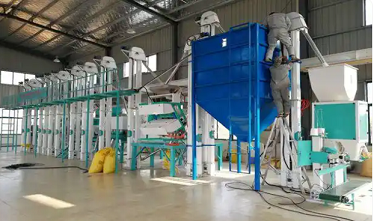
The process starts with raw grain receiving and preliminary cleaning. When millet delivery trucks enter the plant, raw grain first falls into the grain unloading pit and is lifted by a bucket elevator to a preliminary cleaning sieve. This step is critical, as freshly harvested millet is usually mixed with large impurities such as straw, stones and clods. Using a vibrating screen and air separation, the pre-cleaner effectively removes over 50% of large impurities, reducing the load on subsequent equipment. The pre-cleaned millet is then sent to a temporary storage bin and fed evenly into the next stage via a flow controller, ensuring continuous and stable operation and avoiding blockage or idling caused by uneven feeding.
Next comes the key stage of fine cleaning and stone removal. Millet is small, light in specific gravity and often contains “parallel stones” of similar size, which can severely damage downstream husking equipment and compromise food safety if not removed. The production line adopts a combined cleaning sieve and a gravity stoner working in tandem. The combined cleaner uses multi-layer screens with different apertures to classify and remove large, small and light impurities. The material then enters the gravity stoner, which accurately separates stones from millet based on their different suspension velocities under air flow and vibration. A magnetic separator is usually installed in this stage to adsorb metal impurities such as nails and iron wires, establishing a safety barrier for subsequent processing.
The thoroughly cleaned millet enters the husking process, a decisive step for milling yield. A 30-ton production line is typically equipped with a rubber-roll husker, which strips the husk by rubbing grains between two rubber rollers rotating in opposite directions at different speeds. Precise adjustment of roll pressure and speed ratio is required to ensure high husking efficiency while avoiding brown rice breakage. The mixture after husking — consisting of brown rice, unhulled millet and chaff — is then sent to a paddy-rice separator. By utilizing differences in particle size, specific gravity and friction coefficient, the separator screens and winnows the mixture to separate brown rice from unhulled grains. Unhulled millet is automatically recycled back to the husker for reprocessing in a closed loop until the standard husking rate is achieved.
The separated brown rice must undergo milling and polishing to become glossy millet. The modern mainstream technique is multi-stage light milling: 2 to 3 passes of milling machines gradually remove the bran layer from brown rice, preventing excessive single-pass milling that increases broken rice. The grains then enter a polisher, where fine water mist is applied and surface bran powder is removed through friction between grains, resulting in a smooth, glossy appearance and improved marketability. A color sorter is also integrated into the line, using high-definition cameras to identify and remove discolored grains, diseased kernels and residual impurities, ensuring a finished product purity of over 99.9%.
Finally comes the measuring and packaging stage. Qualified millet is lifted to a finished product bin, weighed by an automatic quantitative packaging scale, and packed into vacuum or ordinary bags. The bags are then stitched, inspected by a metal detector, and stored in the warehouse.
The entire 30-ton rice mill processing line is integrated through a central control system, realizing fully enclosed and dust-free operation from raw grain to finished product. This not only significantly reduces labor costs but also guarantees food hygiene and safety. Through refined operation, the process converts rough field-harvested millet into high-quality millet, meeting consumer demand for healthy coarse grains while bringing considerable economic benefits to growers, demonstrating the core value of modern grain processing technology.
Post time:
May-06-2026