

Rice Milling Production Line Evaluation: Comprehensive Analysis and Configuration Recommendations
In today’s grain processing industry, rice milling equipment is one of the core production tools, and its performance and efficiency directly affect the output quality and economic benefits of the entire production process. Especially for companies planning to invest in or upgrade existing production lines, choosing the right rice milling equipment is a crucial step. This article will evaluate a 120-ton/day rice milling production line, aiming to provide users with comprehensive configuration recommendations, selection guidance, and precautions before and after production line operation.
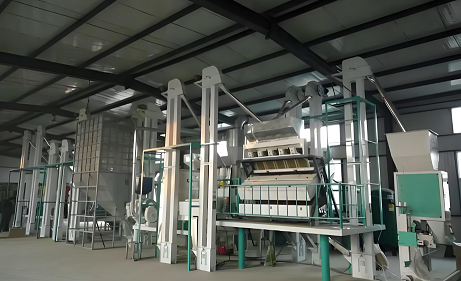
I. Configuration Recommendations
For a 120-ton/day rice milling production line, selecting suitable key equipment such as rice milling machines, polishing machines, and color sorters is essential. The rice milling machine should have high-precision grinding capabilities to ensure the integrity and taste of the rice; the polishing machine needs to be able to evenly process the rice surface to improve the gloss of the finished product; the color sorter needs to have high recognition accuracy to remove impurities and substandard particles. In addition, corresponding auxiliary equipment, such as conveyor belts and dust removal devices, should be provided to ensure the continuity and cleanliness of production. Meanwhile, considering potential future production growth, it is recommended to choose equipment systems that are highly scalable and easy to upgrade and maintain, thereby ensuring long-term economic efficiency and effectiveness.
II. How Ordinary People Should Choose Production Capacity
For ordinary investors entering the rice milling industry for the first time, choosing the appropriate production capacity is a crucial decision. Generally, a 120-ton/day production line is suitable for medium to large-sized rice mills or cooperatives. It can not only meet significant market demand but also reduce unit costs and improve profitability through economies of scale. However, newcomers may prefer to start with a smaller capacity, such as 30-60 tons/day. This not only reduces initial investment risk but also facilitates the gradual accumulation of experience and technical expertise. Therefore, when deciding on the production line size, it is necessary to comprehensively consider one’s own financial situation, market research results, and long-term development plans to make the most suitable choice.
III. Preliminary Preparations
Before officially starting production, thorough preliminary preparations are essential. First, it is necessary to rationally plan the site, including the layout of the production workshop, the setting up of raw material warehouses, and the arrangement of finished product warehouses, to ensure smooth and safe material flow. Secondly, it is essential to organize personnel training covering operational skills, safety regulations, and quality control, ensuring that every employee is proficient in equipment operation and develops good work habits. Finally, detailed production plans and contingency plans are also necessary to address potential emergencies and ensure the stable operation of the production line.
IV. Industry Prospects and Profits
In recent years, with the increasing demand for healthy diets and the growing national emphasis on food security, the rice milling industry has ushered in unprecedented development opportunities. On the one hand, the trend of consumption upgrading has driven increased demand for high-end, high-quality rice, prompting companies to continuously optimize their product structure and increase added value. On the other hand, the application of intelligent and automated technologies has significantly improved production efficiency, reduced labor costs, and enhanced market competitiveness. According to relevant statistics, the overall profit margin of my country’s rice milling industry remains at a high level, especially for companies with their own brands and a focus on quality management, which often reap even greater rewards. Of course, it is worth noting that fierce market competition also means higher operating pressure; only by continuously innovating and adapting, and keeping up with industry trends, can companies remain competitive in a complex and ever-changing environment.
In conclusion, the 120-ton/day rice milling production line, as a highly efficient and stable production model, will remain a target for many rice milling companies in the present and for some time to come. However, to go further on this path, a multi-pronged approach is needed, focusing not only on equipment selection and process improvement but also on talent development and market expansion. Only in this way can they stand out in the increasingly fierce competition and achieve sustainable and healthy development.
Post time: Feb-22-2026