

A rice milling production line is an important piece of equipment used in rice processing. Its main function is to remove the husk from paddy rice and further refine it into rice products that meet market demands. This article aims to explore the process flow and working principle of a 120-ton rice milling production line, and analyze the importance of optimizing process parameters for improving production efficiency and processing quality.
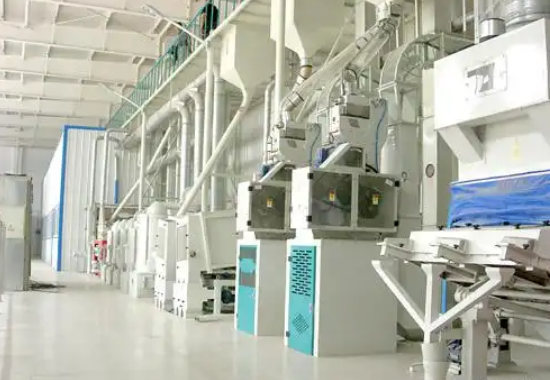
I. Overview of a 120-Ton Rice Milling Production Line
A 120-ton rice milling production line typically includes main processes such as paddy cleaning, hulling, milling, white rice grading, and color sorting. Paddy cleaning removes impurities from the paddy rice to ensure the smooth progress of subsequent processes; the hulling process mechanically removes the husk from the paddy rice; the milling process smooths the surface of the brown rice inside the paddy rice; white rice grading and color sorting are used to classify the milled rice by grain size and color, respectively, ultimately yielding a high-quality product.
II. Production Process and Working Principle
1. Paddy Cleaning
The main purpose of paddy cleaning is to remove impurities such as stones, soil, and rice leaves from the paddy, reducing wear and tear in subsequent processes. Common cleaning methods include air separation, magnetic separation, and sieving. These methods effectively improve the cleanliness of the paddy, providing good raw material conditions for subsequent processes.
2. Hulling
The hulling process removes the husk from the surface of the paddy to facilitate more efficient milling. This process is usually completed using a hulling machine, which applies pressure to the paddy using a high-speed rotating grinding wheel or roller to remove the husk. Ideally, hulling should remove as much husk as possible while maintaining the integrity of the paddy.
3. Milling
The milling process is the most critical step in the entire production process, directly determining the quality of the finished rice. The milling machine gradually removes the bran from the surface of the brown rice until the required precision is achieved. The rice milling process requires careful control of milling pressure and time. Excessive pressure increases the rate of broken rice, while insufficient pressure fails to achieve the desired milling effect.
4. Rice Grading and Color Sorting
Rice grading is primarily used to differentiate rice grains of different sizes, ensuring product uniformity. Color sorting utilizes optical technology to filter rice by color, removing yellowed or otherwise defective grains, thereby improving the appearance quality of the finished product.
III. Process Parameter Optimization
Optimizing process parameters is crucial for improving production efficiency and processing quality. By adjusting key parameters such as hulling pressure, milling time, and temperature, the quality of the finished rice can be significantly improved. For example, appropriately reducing hulling pressure can increase husk removal while preserving the integrity of the paddy; while properly controlling milling time and temperature can effectively prevent rice breakage caused by over-milling.
IV. Equipment Cost Analysis
According to market research, the prices of rice milling production lines vary significantly depending on their scale. The price range for small-scale production lines (daily processing capacity of approximately 10-30 tons) is roughly between 150,000 and 250,000 RMB; for medium-sized production lines (daily processing capacity of approximately 30-100 tons), the price range is between 250,000 and 1,000,000 RMB; and for large-scale production lines (daily processing capacity exceeding 100 tons), the price range for the complete set of equipment is approximately between 1,000,000 and 1,500,000 RMB. The cost of equipment directly affects the return on investment cycle for enterprises; therefore, factors such as capacity requirements, product quality, and long-term operating costs should be comprehensively considered when selecting equipment.
Conclusion
The efficient operation of a 120-ton rice milling production line not only relies on advanced machinery and equipment but also requires a scientifically sound process design and precise control of process parameters. Through in-depth research and optimization of each link in the production line, not only can production efficiency be significantly improved, but the quality of rice products can also be effectively guaranteed, thereby bringing greater economic and social benefits to enterprises.
Post time: Sep-01-2026