

Development History and Current Status of Rice Milling Machines
Rice, as an important agricultural product in southern my country, has an annual output of up to 180 million tons, accounting for about 40% of the total grain output. Against this backdrop, the rice milling machine, as the core equipment for rice processing, has an undeniable impact on the modern grain industry. Currently, the most common rice milling machines on the market mainly employ two technologies: friction wiping whitening and milling whitening. These technologies remove the outer husk of brown rice through mechanical force to complete the whitening process. It is worth mentioning that the hybrid whitening technology combining friction wiping and milling not only effectively reduces the broken rice rate but also improves rice quality, increases work efficiency, and reduces power consumption. Therefore, hybrid rice milling machines dominate the Chinese rice milling machine market, fully integrating the advantages of both whitening technologies to bring users superior whitening results.
1. Current Technological Development Status of Rice Milling Machines
Currently, rice milling machines mainly employ friction wiping whitening and milling whitening technologies. It is worth noting that hybrid rice milling machines combine the advantages of both technologies, effectively reducing broken rice rate and improving work efficiency, making them the dominant product in the market. The introduction and popularization of hybrid rice milling machines have made the rice whitening process more efficient and energy-saving.
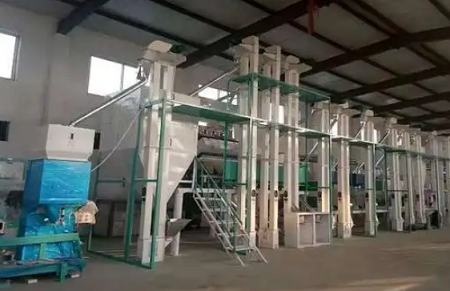
2. Historical Development of Rice Milling Machines
The Development of Rice Milling Machines in China
The development of my country’s rice milling machine industry initially involved improvements to the horizontal iron roller rice milling machine introduced from Britain. In the 1850s, rice whitening iron roller rice milling machines that did not separate rice bran were widely used in rural areas. By the 1880s, with the reform and opening up, rice bran-separating iron roller rice milling machines gradually replaced those that did not separate rice bran. In the 1990s, air-jet iron roller rice milling machines with air-jet devices were introduced, producing rice with a bright color, high smoothness, low temperature rise, and high rice yield. This type of machine has seen rapid development in modern times.
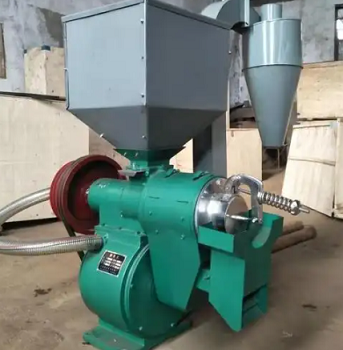
The History of Rice Milling Machines Abroad
The history of rice milling machines abroad is equally long. In the 1760s, Europeans developed the vertical mortar rice mill, laying the foundation for rice milling technology. In the 1790s, Americans improved upon the vertical mortar rice mill, inventing the horizontal iron roller rice mill. This breakthrough propelled the rapid development of rice milling technology. Subsequently, in the 1820s, the Japanese company Satake developed a high-performance vertical rice mill based on the iron roller rice mill technology. Among them, the BF7B-C/MC reverse vertical iron roller rice mill employs a unique vertical layout, with the feeding device at the bottom of the whitening chamber and the discharge device at the top. This design significantly improves the processing efficiency of polished rice, reduces material transport equipment, and lowers the broken rice rate.
3. Different Types of Rice Mills
Scrubbing Rice Mills
Currently, rice mills are mainly divided into three categories: scrubbing type, milling type, and mixed type. The rubbing-type rice milling machine, also known as the iron roller rice milling machine, processes brown rice using friction between rice grains, between rice grains and the milling roller, and between rice grains and the rice sieve. Its characteristic is the smooth surface of the iron roller, resulting in highly smooth rice and low starch content in the bran. However, a drawback is that the friction of the iron roller is relatively low; increasing the pressure inside the milling chamber to improve the whitening rate may cause rice grain breakage, producing broken rice.
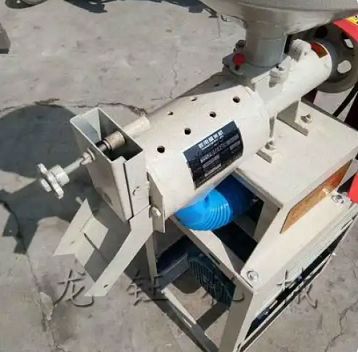
The grinding-type rice milling machine is widely used in my country. Its core component is a sand roller, not an iron roller, which allows it to more effectively complete the milling task, efficiently whitening brown rice. Compared to the rubbing-type rice milling machine, it performs better in removing the brown rice bran, thus significantly reducing the broken rice rate. However, it is worth noting that the brown rice bran is rich in various nutrients, so the grinding-type rice milling machine may cause nutrient loss during the whitening process. Furthermore, the produced rice is not as uniform in quality, and the surface of the finished rice is relatively rough.
Representative International Models
Of particular note is the NF14 rotary screen air-jet rice milling machine, whose innovative air-jet technology ensures ample airflow and significant results. Its unique whitening chamber design further enhances the whitening effect while accelerating the bran removal process and reducing rice temperature, thereby increasing yield and milling precision. Internationally, the VTA7A-C vertical sand roller rice milling machine is a representative model produced by Satake Corporation of Japan. Its basic structure is similar to that of vertical sand roller rice milling machines in my country, but it employs a unique design that significantly increases yield and reduces floor space. Even more noteworthy is the cleverly designed rotary discharge device at the bottom of its whitening chamber, allowing for smooth discharge of rice bran from the machine.
Post time: Feb-27-2026