

Coconuts are a high-yield tropical oilseed crop, and coconut oil is mainly produced by pressing dry coconuts. This article analyzes the production process of coconut oil using a conventional process with a 20t/d large-scale screw oil press as an example.
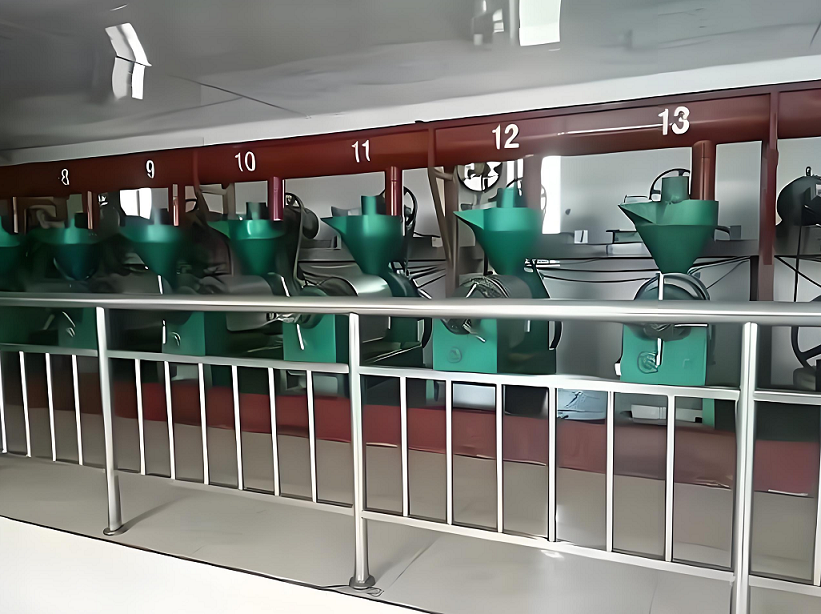
The main equipment components of a 20T/D coconut oil press production line are: 1 hammer mill, 1 rolling mill, 1 steaming and frying pan, 2 screw oil presses, 1 settling tank, 1 centrifugal oil residue separator, 5 chain elevators, and 1 belt conveyor.
Coconut Oil Extraction Production Line Process and Points to Note
1. Dry Coconut Conveying: Dry coconut raw materials are lumpy solids and are not suitable for conveying by elevators. Imported small scraper conveyors are too small, resulting in uneven feeding, while large scraper conveyors are too expensive. Therefore, belt conveyors are selected, and their inclination angle should not exceed 30 degrees, otherwise material will easily fall off. Before crushing, an iron removal device should be installed on the conveyor to prevent metal substances from damaging the processing equipment and to ensure the quality of the coconut oil cake.
2. Crushing: Dried coconut meat is a tough, blocky solid obtained by drying coconut meat, with dimensions of 180 cm x 100 mm x 6 mm. Therefore, the first problem to solve is the crushing of dried coconut meat. A hammer mill should be used, with larger screen apertures and fewer hammers, evenly arranged across the surface. Dried coconut is a high-oil-content material, so a chain elevator should be used to convey the crushed material.
3. Rolling: Dried coconut has a high oil content, and if the rolling gap is too small, oil will easily seep out. Furthermore, after crushing and conveying, the oil has already seeped into the surface of the material, easily clumping and sticking to the rollers, leading to difficulties in rolling or even blockages. If the dried coconut is hard and tough, with low density, and the roll gap is too small, the material will accumulate between the two rolls.
4. Steaming and Roasting: Due to the continuous stirring in the steaming and roasting pan, the dried coconut easily comes out of the pan, dripping oil down the main shaft, causing waste in the workshop and environmental pollution. At the same time, the material is prone to clumping, making transportation difficult. Solutions: 1. Reduce the degree of material pulverization, shorten stirring time, and frequently clean the discharge nozzles of the steam fryer and the elevator to prevent material accumulation.
5. Oil Extraction: Due to the different properties of pulverized dried coconut oil compared to regular oil, problems such as no feed, no cake, and no oil at the oil outlet of the press cage may occur. Therefore, it is necessary to adjust the gap between the pressing bars. When extruding dried coconut material, the gap between the bars should be very small. After improving the steaming and frying conditions, the feeding is normal, and oil is mainly produced in the second and third stages. It is worth mentioning that at the beginning of feeding, before the temperature in the pressing chamber rises, the flow rate of material entering the pressing chamber should not be large, otherwise it is easy to form a thin paste at the feeding point, leading to poor cake output or even sintering.
6. Oil Clarification and Filtration: Dried coconut contains a large amount of fiber, so the crude oil contains a large amount of slag. To reduce the burden on the filter, an oil clarification process is set up in the process flow, directly returning the oil slag to the oil press for oil extraction. The linear velocity of the scraper in the oil clarification tank is 3.73 mm/s. The crude coconut oil obtained is then subjected to five stripping processes in the refining equipment to obtain coconut oil.
Post time: Jan-28-2026