

1. Preparations Before Start-up Rice Grader
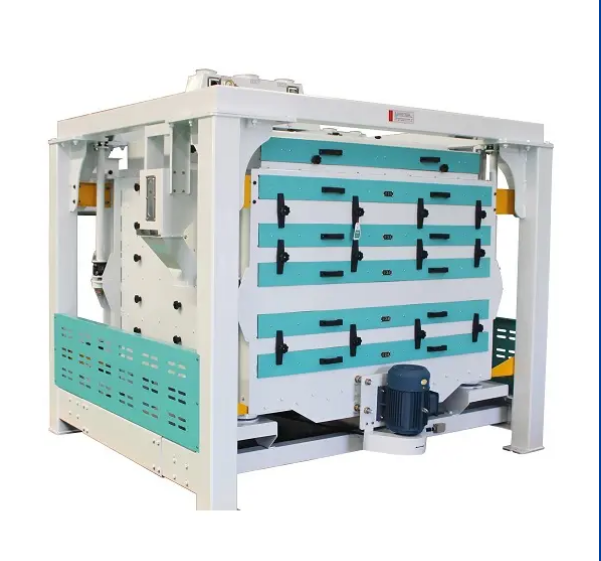
1) Before starting the machine, remove the four safety clamps used for transport and fixing.
2) Trial Run
After the equipment is installed, carefully inspect and adjust it. Once no abnormalities are confirmed, connect the power supply and run it without load. During startup and no-load operation, pay attention to any abnormal noises (excluding vibration damper collisions), and check if the motor load is normal. If any unexpected situations occur, stop the machine immediately and check the cause of the fault. Ensure the transmission parts operate smoothly without collisions or friction noises, that the booms are of consistent length, the screen body is level, and the screen surface is taut. After the equipment trial run is normal, it can be put into normal operation.
2. Factors Affecting the Effect of Planar Rotary Vibration Process
1) Rotation Speed
The rotation speed of the screen body is the main factor affecting the relative speed of the material on the screen surface. High rotation speed results in a fast relative movement of material on the screen surface, leading to strong automatic grading. However, material penetration is more difficult, and excessively high speed can also affect the amount of undersize material. Conversely, slow rotation speed results in a slow relative movement of material on the screen surface, leading to poor automatic grading. However, material passes through the screen holes more easily, potentially allowing unwanted material to pass through and affecting the purity of the undersize material. The screen rotation speed is adjusted by changing the opening and closing of the speed-regulating pulley, and this adjustment must be performed while the screen is stopped. If the motor plate and motor are adjusted to a position away from the screen body, the tension of the V-belt increases. When the tension of the V-belt exceeds the spring force, the opening and closing of the speed-regulating pulley increases, causing the V-belt to move inward, reducing the diameter of the drive pulley and slowing down the speed. Conversely, the speed increases.
2) Screen Surface Inclination Angle
The screen surface inclination angle is also a factor affecting the flow speed of material on the screen surface. Increasing the screen surface inclination angle increases the material flow speed, which can easily lead to incomplete screening. While ensuring screening quality, the inclination angle can be appropriately increased to improve output.
3) Screen Aperture Size and Screen Surface Length and Width
The size of the screen aperture should be determined based on factors such as the particle size of the material to be screened, the flow rate, and process requirements. From a process requirements perspective, the larger the screen aperture, the greater the probability of rice grains passing through the screen. When configuring the screen aperture, it should be ensured that the first layer of screen outlets does not contain broken rice, and the last layer of screen undersize does not contain whole rice grains. The screen surface length is closely related to the screening efficiency of the equipment. To ensure sufficient screening path for the material and to give materials smaller than the screen aperture more opportunities to pass through, the screen surface length is generally taken as 1500 mm. The screen surface width determines the production capacity of the equipment. When the flow rate per unit screen width is constant, the wider the screen surface, the greater the production capacity; however, an excessively wide screen surface will cause uneven flow layer along the screen width direction, affecting the screen surface efficiency.
4) Flow Rate
Under normal circumstances, the flow rate should be maintained at around 60 kg/cm·h. Flow rates that are too high or too low make it difficult for the material to fully form automatic grading on the screen surface, thus reducing grading efficiency. Therefore, a stable and appropriate flow rate should be maintained during production.
5) Suction Volume
A suction port is installed at the feeding and leveling device to reduce the temperature and humidity of the incoming material and prevent dust and mold growth inside the machine. The suction volume should be adjusted to remove dust.
6) Screen surface cleaning.
To ensure effective screening, the actual cleaning effect of the cleaning device must be checked frequently, especially the lower screen surface. Generally, more than 80% of the screen holes should be kept clear.
3. Adjustment of Rice Grader
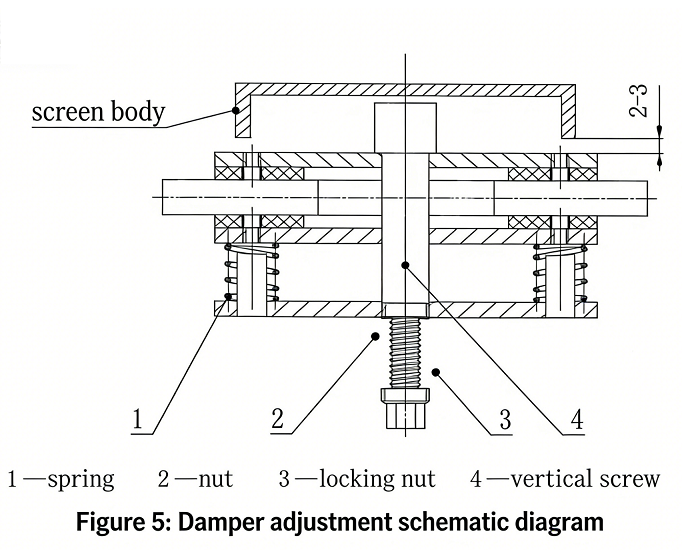
During installation, place a level on the screen plate to find the level. The inclination of the screen boat is adjusted using a wire rope sling, and then tightened with a nut. The gap between the damper and the screen boat must be checked; this gap is generally between 3-5mm, see Figure 5.
1) Adjusting the damper
The damper is used to reduce resonance that may occur during start-up and shutdown, avoiding collisions between the screen boat and the frame. However, the damper’s buffering force must be appropriate; otherwise, too little force will not provide a buffering effect, while too much force will cause the screen boat to collide with the damper for a long time. Therefore, the damper must be adjusted. To increase or decrease the damper’s buffering force, adjust as follows (see Figure 5):
A. Loosen the locking nut 3.
B. Use a wrench to hold the lower end of the vertical screw 4 to prevent it from rotating.
C. Tighten or loosen nut 2 to apply the required pressure to spring 1. This pressure should be such that you cannot feel a noticeable rebound force when pushing the screen boat by hand. Ensure that the spring lengths on both dampers are equal.
D. Tighten the nut.
Please contact us if you have any inquiry about rice grader!
Post time: Apr-03-2026