

The production of peanut oil in an oil mill is a complex process involving multiple stages and various pieces of equipment. From the pre-treatment of raw materials to the refining of the oil, each step requires specialized machinery and technology to ensure the quality and safety of the final product. Below, we provide a detailed overview of the equipment used in peanut oil production and the steps involved in the refining process.
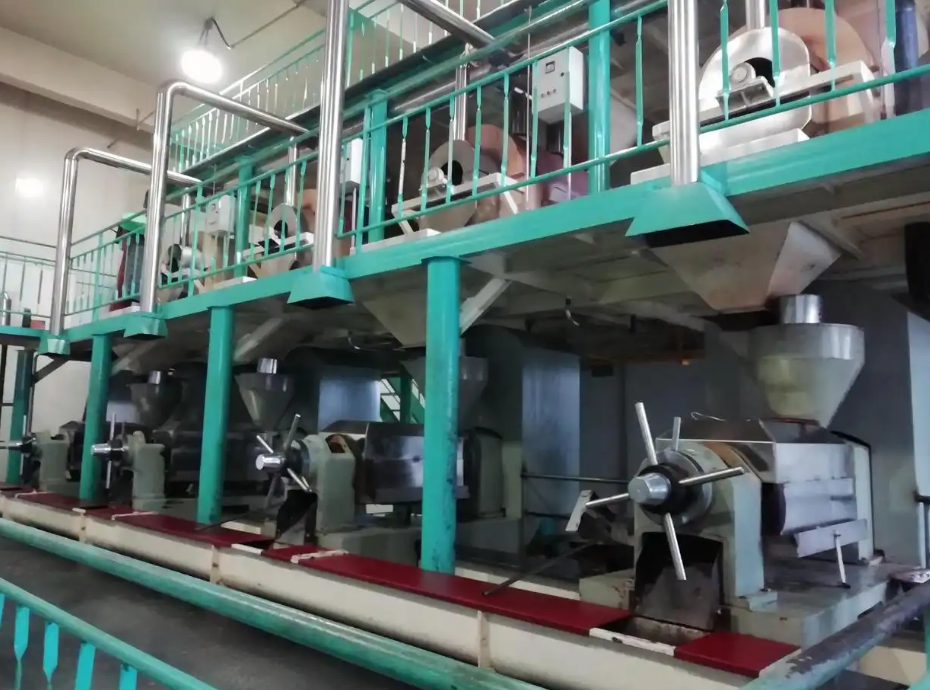
First, let us examine the equipment required for peanut oil production. The initial stage is raw material pre-treatment, which includes cleaning, crushing, and steaming the peanuts. Consequently, an oil mill requires equipment such as peanut cleaning machines, crushers, and steaming vessels. This is followed by the pressing stage, which utilizes screw oil presses or hydraulic oil presses to efficiently extract oil from the peanuts. The resulting peanut cake undergoes further processing—such as drying and grinding—for subsequent use. Additionally, the facility must be equipped with oil storage tanks, pipelines, and measuring instruments to ensure accurate storage, transport, and quantification of the oil.
Next, we will focus on the peanut oil refining process. Refining is designed to remove impurities, off-odors, and pigments from the oil, thereby enhancing its quality and sensory characteristics. The refining process primarily consists of degumming, deacidification, bleaching (decolorization), and deodorization.
Degumming is the first step, aimed at removing phospholipids and other colloidal substances from the peanut oil. Through heating and the addition of chemical agents, these colloidal substances—primarily phospholipids—are induced to aggregate into larger particles, which are then removed via centrifugation or filtration.
This is followed by deacidification, which serves to reduce the content of free fatty acids in the peanut oil. This is typically achieved through either alkali refining or distillation. In alkali refining, a measured amount of an alkaline solution is added to neutralize the free fatty acids, forming soapstock and glycerol; the soapstock is subsequently removed through centrifugation or filtration. Distillation, by contrast, leverages the volatility of fatty acids at high temperatures, removing them through heating and vacuum distillation.
Next comes bleaching (decolorization), a step primarily focused on removing pigments from the peanut oil to achieve a clearer, brighter appearance. Adsorption-based decolorization is commonly employed, utilizing adsorbents such as activated carbon to capture pigments and other impurities present in the oil. Activated carbon is mixed with the peanut oil; after a period of contact, the carbon—along with the adsorbed impurities—is removed through filtration.
The final stage is deodorization, which aims to eliminate off-odors and volatile substances from the peanut oil, thereby improving its flavor profile and stability. This is typically achieved through high-temperature vacuum distillation: under conditions of high heat and a vacuum, odorous compounds are volatilized and subsequently removed via condensation and collection.
Following these refining steps, the quality of the peanut oil is significantly enhanced, meeting standards for human consumption. The process concludes with cooling and packaging; the refined peanut oil is cooled and then filled and sealed using automated packaging equipment, preparing it for storage and sale.
In summary, the production of peanut oil in an industrial facility requires a range of specialized equipment and technical expertise. Every stage—from raw material pretreatment to pressing, refining, and packaging—demands rigorous control and precise operation to ensure the quality and safety of the final product. Each step in the refining process serves a distinct purpose, collectively forming the complete production workflow. Through continuous technological innovation and equipment upgrades, oil producers can further enhance the quality and yield of their peanut oil, effectively meeting market demand and driving the advancement of the industry.
Post time: Oct-29-2026