

The output of a complete rice milling machine is mainly determined by the following factors. For a small-to-medium-sized rice production line with a daily output of 30 tons, the specific analysis is as follows:
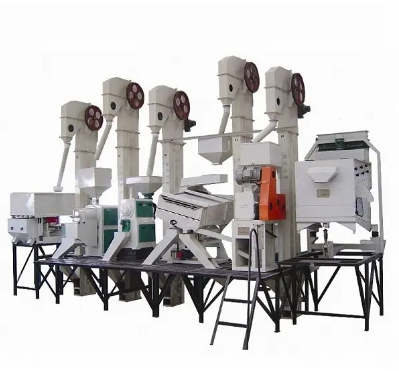
Equipment Efficiency: The operating speed, processing capacity, and production efficiency of the equipment are core indicators. For example, parameters such as the rotational speed of the rice mill, screen specifications, and whitening chamber pressure directly affect the amount of paddy processed per unit time. For a production line with a daily output of 30 tons, it is necessary to select equipment models that match the capacity to avoid a decrease in overall capacity due to insufficient efficiency of individual machines. At the same time, the stability of the equipment (such as continuous operating time and failure rate) will also indirectly affect the actual output.
Process Control: The production line needs to be equipped with an automated control system to monitor parameters of each process in real time (such as the gap between the rubber rollers of the huller, the whitening pressure of the rice mill, and the sensitivity of the color sorter). By precisely controlling conditions such as temperature, humidity, and time, the paddy breakage rate can be reduced, the rice yield increased, and thus the output optimized. For example, in the rice hulling process, excessively large gaps between the rubber rollers will lead to a decrease in the hulling rate, while excessively small gaps will increase the broken rice rate; both require dynamic adjustment through the control system.
Raw Material Input: The quantity and quality of raw materials directly affect output. A daily production capacity of 30 tons requires ensuring a sufficient and stable supply of raw materials to avoid downtime due to shortages. Simultaneously, the quality of raw materials (such as moisture content, impurity content, and rice variety) must meet equipment requirements. For example, excessively high moisture content will easily clog the screen during milling, while excessively low moisture content will increase the broken rice rate; both require pretreatment (such as drying or softening) to adjust to the optimal range.
Energy Consumption: Equipment energy consumption is closely related to production capacity. High-efficiency motors, variable frequency speed control technology, and waste heat recovery devices can reduce energy consumption per unit output and improve overall efficiency. For example, a rice milling machine using variable frequency control can automatically adjust power according to raw material flow, avoiding energy waste. For a production line with a daily output of 30 tons, energy costs account for approximately 15%-20% of total operating costs; optimizing energy consumption can significantly reduce production costs.
Regular maintenance of equipment (such as replacing worn parts, cleaning accumulated dust, and lubricating the transmission system) ensures long-term stable operation. For example, clogged rice milling machine screens lead to reduced production capacity and require daily cleaning; worn rubber rollers affect the hulling rate and require regular replacement. Furthermore, operator training (such as correctly adjusting equipment parameters and handling unexpected malfunctions) is also crucial for ensuring production capacity.
Special Considerations for a 30-ton-per-day Production Line: Small and medium-sized production lines need to balance efficiency and cost in equipment selection, process flow, and space layout. For example, modular design allows for flexible capacity adjustments and reserves space for upgrades; optimizing material conveying paths (such as shortening elevator height and reducing turns) reduces losses. Simultaneously, backup equipment (such as backup motors and screens) must be configured to cope with unexpected malfunctions and ensure stable daily output targets are met.
As a manufacturer and service provider of complete rice milling equipment ranging from 18 tons to 1000 tons/day, FOTMA MILL provides comprehensive technical support to its customers. Its Model 30 series complete rice milling equipment features the following characteristics:
● Utilizes the latest improved combined cleaning and destoning screen, resulting in superior processing performance, low energy consumption for destoning, and low investment.
● The hulling machine employs the most advanced hulling principle, ensuring noiseless and slip-free operation, maintaining a consistent linear speed difference, increasing hulling rate, achieving high output, minimizing breakage, facilitating operation and adjustment, and reducing noise.
● Employs our company’s unique rice milling machine, achieving high rice milling precision, minimizing breakage, and a 2% higher rice yield and half a grade higher precision than similar products.
● The gravity coarse rice screen is easy to operate, has a low failure rate, and offers high output despite a small screen area.
● All components are made of national standard materials, ensuring long service life, low failure rate, and stable and reliable processing performance.
● Utilizes a steel frame platform, featuring a compact and reasonable structure that is both aesthetically pleasing and convenient for operation and maintenance, with simple installation.
● This equipment can be easily supplemented with subsequent equipment (such as polishing machines, color sorters, electronic packaging scales, etc.) according to customer requirements.
Start your project and get a free quote NOW!
Post time: Mar-09-2026