

Flour, as a fundamental raw material for the daily diet of Chinese residents, directly impacts food security and industrial upgrading through the sophistication of its processing machinery. As the grain and oil processing industry moves towards intelligent and large-scale operations, flour mill processing machinery is undergoing a historic leap from traditional single machines to automated production lines, and from coarse processing to deep processing. Currently, China’s flour processing machinery industry has formed a complete industrial chain covering the entire process of cleaning, milling, and packaging, demonstrating strong vitality in technological innovation and market application.
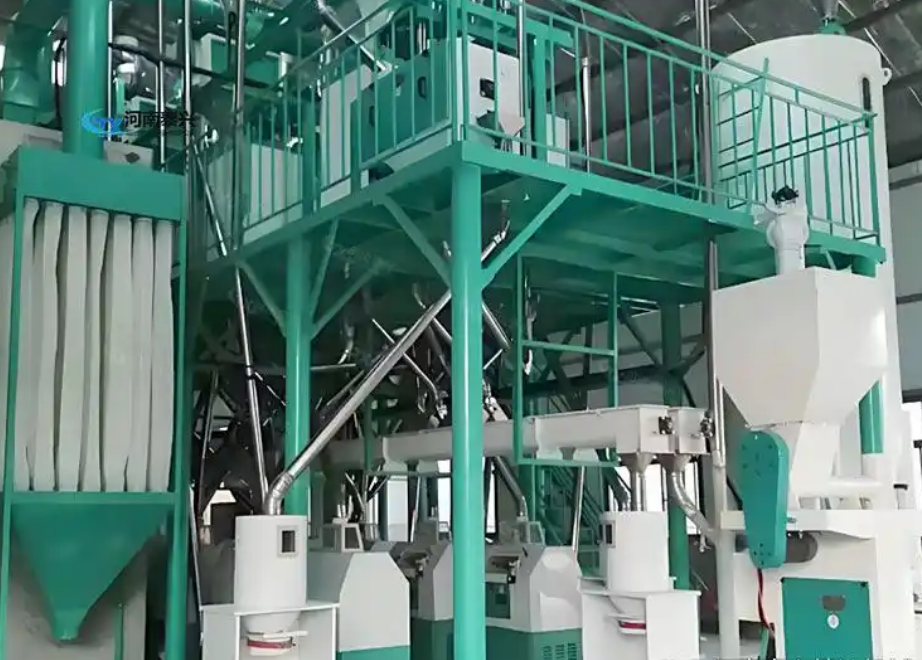
I. Core Equipment Composition and Technological Breakthroughs
The core of modern flour processing machinery lies in the coordinated operation of four major systems: cleaning, grinding, sieving, and packaging. Domestic procurement of flour processing equipment has increased by 23% year-on-year, with high-square flat sieves, pneumatic mills, and intelligent packaging lines becoming popular categories. In the cleaning stage, the new combined cleaning sieve uses a multi-layer vibrating sieve linked with a gravity destoner, achieving an impurity removal rate of up to 99.5%, a 12% improvement over traditional equipment. Flour milling systems generally employ a three-stage process: bran milling, core milling, and residue milling. The newly developed eight-roll mill utilizes differential transmission technology, reducing unit energy consumption by 18% while increasing flour yield to 78%. Notably, FOTMA’s IoT control system can monitor over 20 parameters in real time, including mill roller temperature and vibration frequency, with a fault warning accuracy rate of up to 96%.
II. Deep Expansion of Market Application Scenarios
Flour machinery applications have expanded beyond traditional areas: In the specialty flour market, flour blending systems can precisely control ash and gluten content, meeting the production needs of over 60 types of specialty flours, including those for baking and frozen foods. Under the rural revitalization strategy, modular small units are rapidly gaining popularity in county-level markets; a 50-ton-per-day processing unit requires only 120 square meters of space, shortening the investment payback period to 2.3 years. Alibaba platform transaction data shows that flour machinery exports increased by 41% year-on-year in the first half of 2025, with a surge in demand for small and medium-sized units (15-30 tons/day) in Africa and Southeast Asia. These units often feature both electric and diesel power options, adapting to the infrastructure conditions of developing countries.
III. Three Major Trends in Intelligent Transformation
1. Application of Digital Twin Technology: Some leading companies have begun building virtual commissioning systems, completing over 3000 simulated runs before new equipment goes into production, reducing the actual installation cycle by 40%. A demonstration factory used 3D modeling to recreate the entire production line, and after optimizing the equipment layout, logistics efficiency improved by 27%.
2. Breakthroughs in Green Energy Saving: Pulse dust removal equipment combined with a negative pressure conveying system reduces workshop dust concentration to below 4mg/m³; new grinding roller alloy materials extend the replacement cycle to 1800 hours, saving 150,000 yuan per unit in annual maintenance costs.
3. Flexible Production: The same production line can handle multiple grains such as wheat, corn, and buckwheat through parameter adjustments, with switchover time controlled within 2 hours.
IV. Challenges and Countermeasures Facing the Industry
Despite rapid development, the industrial chain still has shortcomings: the import dependence on core components such as high-end grinding roller bearings and intelligent sensors reaches 35%, and some companies report that the cost recovery period for intelligent equipment transformation exceeds 5 years. Experts recommend a phased implementation strategy, prioritizing the deployment of machine vision systems in quality inspection and packaging, with individual investments kept under 200,000 yuan. At the policy level, the “14th Five-Year Plan for the Grain Processing Industry” explicitly provides a 30% subsidy for technological upgrades, focusing on supporting the CNC transformation of production lines with a capacity of 200 tons/day or more.
In the next five years, with the accelerated industrialization of staple foods, flour processing machinery will develop towards both miniaturization and mega-scale: community smart flour mills will use integrated equipment to achieve on-site grinding and sales, while processing bases with a capacity of hundreds of millions of tons will need to overcome the technological bottleneck of ultra-large-scale units with a capacity of 2,000 tons/day. The focus of industry competition has shifted from single-machine performance to full life-cycle service capabilities, including value-added services such as remote operation and maintenance and process optimization. This requires equipment manufacturers to move beyond simply selling machinery to providing systematic grain processing solutions. Under the dual circulation development pattern, domestically produced equipment, with its cost-effectiveness advantage, is expected to achieve a leap from “follower” to “leader” in the global mid-range market.
Post time: Apr-10-2026