
Grain dryers are generally used to dry raw grains such as corn, soybeans, wheat, and rice. Grain dryers on the market come in various forms depending on the type of grain, working principle, operation method, output, heating temperature, and method. This article describes the classification and selection of several commonly used types of grain dryers to provide users with a reference.
1. Introduction to Grain Dryers
1.1 Intermittent Dryers
Currently, the most commonly used intermittent dryers on the market are circulating dryers. Raw grains can circulate automatically in this type of dryer, resulting in uniform drying and good quality. If the hot air temperature is suitable and the conveying equipment has a good structure and performance, it can also be used for seed drying. The dryer uses conveying equipment that does not easily damage the grain particles. The ventilated drying section adopts the “multi-path thin-layer” principle, and this “multi-path thin-layer” ventilated drying section can be used for grain storage. After ventilated drying, the grain returns to the upper part of the drying section for tempering, which adjusts the internal moisture of the grain particles to be uniform. This type of dryer generally uses low temperature and high air volume, requiring less energy to dry the same amount of raw grain.
1.2 Continuous Dryer
Grain dryers can be classified into four types based on the relative movement direction of the grain and airflow: cross-flow, mixed-flow, co-flow, and counter-flow.
1.2.1 Cross-flow Dryer
A cross-flow grain dryer is one where the grain flow direction is perpendicular to the hot air flow direction. This type of dryer was one of the earliest to be adopted and digested in my country, and is now mostly a square tower type with perforated screens. The advantages of a cross-flow grain dryer are simple production process, low cost, easy installation, and high production efficiency. However, its disadvantages include poor uniformity of dried grain, unsuitability for drying multiple varieties of grain, and difficulty in achieving high-quality dried grain. Small-scale circulating dryers can avoid some of these shortcomings.
1.2.2 Mixed-flow Dryer
A mixed-flow grain dryer is one where hot air passes through the grain layer at different angles via ventilation ducts. The dryer contains numerous angled air intake and exhaust ducts, but the intake and exhaust ducts have two arrangements: one where the airflow is a mixture of counter-current and co-current flow with the grain, and another where the airflow and grain flow are a mixture of cross-current, counter-current, and co-current flow. Most mixed-flow grain dryers manufactured in China use this type of structure. Its advantages include uniform mixing of hot air and grain, high grain uniformity after drying, low unit heat consumption, lower fan power under similar conditions, and a wide range of dryable grains, including both grains and seeds. However, its disadvantages include a complex structure and high manufacturing cost under similar conditions.
1.2.3 Co-current Dryer
A co-current grain dryer operates in the same direction as the hot air flow. It typically features a tower structure combining a funnel-shaped intake duct and angled box exhaust ducts. Unlike mixed-flow dryers which use a single main duct for hot air supply, co-current dryers use multiple (stages) of hot air ducts supplying different or partially identical hot air. Some domestic manufacturers use this type of co-current grain dryer. The advantages of a co-current dryer are high hot air temperature (up to 250℃) and a large moisture reduction (10%–15%), making it suitable for drying grains with high moisture content. However, its disadvantages include a more complex structure, higher manufacturing costs, and a higher unit price.
1.2.4 Counter-current Dryer
A counter-current grain dryer operates with the grain flowing in the opposite direction to the hot air. This type of dryer does not have a fixed grain layer thickness, so it can operate normally with or without a dedicated moisture silo. The drying zone is located at the bottom of the grain pile. Once the grain at the bottom of the drying zone reaches a certain dryness level, it is conveyed out by a rotating screw conveyor, thus preventing over-drying. Its disadvantage is that during the drying process, dust in the grain gradually concentrates towards the center, clogging the perforated plates, requiring the machine to be stopped and cleaned periodically. Its application range is relatively limited; it is mostly used in conjunction with other airflow dryers, i.e., in the cooling section of co-current or mixed-flow dryers, forming co-current/counter-current or mixed-counter-current dryers.
2. Grain Dryer Classification
Based on heating temperature, the following are classifications of grain drying temperatures for commonly used circulating and continuous dryers.
Continuous dryers use high-temperature heating, typically with hot air temperatures not lower than 90℃, enabling rapid drying. They are advantageous for high-moisture grains requiring rapid drying and have a large installed capacity, generally 100-200 tons per unit.
Circulating dryers use low-temperature heating, typically with hot air temperatures not exceeding 60℃. They have a longer drying time, generally requiring 8-10 hours of self-circulation before reaching the storage area. Single-unit installed capacity ranges from 10-60 tons. To meet high-volume drying demands and market needs, several low-temperature circulating dryers are often connected in parallel to form a drying line. Some manufacturers now offer installed capacities reaching 120 tons per unit or even higher.
3. Grain Dryer Selection: What type of dryer is best for rice, corn, and wheat?
3.1 High-Temperature Continuous Grain Dryer
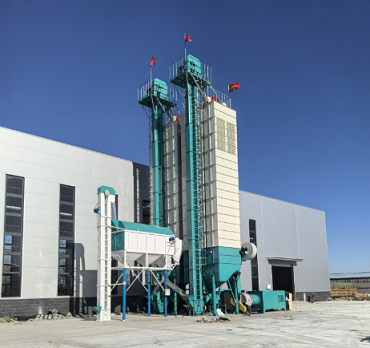
High-temperature continuous grain dryers are commonly used for drying rice, wheat, and corn. These dryers feature high drying temperatures, large moisture reduction, high throughput, high efficiency, and a tall appearance, yet they occupy a small area. Considering construction costs, the drying lines are typically built outdoors, meaning the dryers are placed in the open. Only the foundation equipment needs to be constructed, saving on factory building costs and shortening the construction period, thus reducing overall purchase and construction costs. Electrically, PLC control enables automated drying, ensuring a safe and reliable drying process.
Customers choosing high-temperature continuous grain dryers are primarily concentrated in Northeast and North China, or in East and South China where faster drying is prioritized, such as drying centers and grain traders.
3.2 Low-Temperature Circulating Grain Dryer
Low-temperature circulating grain dryers are commonly used for drying rice and wheat. This type of dryer produces grain with good uniformity and quality, and is often used as an important step in seed and rice processing. It typically uses several machines connected in parallel as a drying line, usually around 15 meters high. The increased number of conveying devices after parallel connection necessitates indoor placement, making outdoor placement unsuitable. This results in high purchase and construction costs and a long development cycle. Including planning approvals, civil engineering construction time, and equipment installation, it generally takes at least six months to be ready for grain intake. Electrical control can be automated via PLC, ensuring a safe and reliable drying process. Some manufacturers now also offer intelligent operation via mobile app, increasingly aligning with the Internet of Things era.
Regarding the geographical location and type of customers choosing low-temperature circulating grain dryers, they are primarily concentrated in Central, South, and Southwest China, or are customers prioritizing drying quality, such as seed companies and rice mills.
4. Development Trends in the Grain Drying Industry
Market With the gradual increase in market demand, the performance requirements for grain drying are becoming increasingly stringent. FOTMA is continuously striving to research grain drying equipment that better meets market demands, considering aspects such as equipment technology, structural integration, finished product quality, and ease of construction. In recent years, with the continuous improvement of mechanization in grain harvesting, the harvest period has been greatly shortened. Traditional natural sun-drying can no longer meet market demands. If the moisture content of raw grain is not reduced to a safe range in time, especially in the Jiangsu and Zhejiang areas where continuous rain is common during the wheat harvest season, it can cause significant losses to the grain. Statistics show that losses due to mold and rot generally account for about 4% to 5% of the total yield each year, with national grain losses exceeding 10 million tons annually. Therefore, in order to ensure the safety of raw grain and guarantee a bumper harvest, the market demand for FOTMA grain dryers has increased rapidly, and national policies for the development of agricultural machinery have also promoted the entry of grain dryers into the post-harvest processing stage of raw grain.
Post time: Nov-27-2025