

I. Overview of High-Speed Hydraulic Sesame Oil Press
The sesame oil press is mainly used for individual household processing. This product belongs to the category of fully automatic hydraulic oil presses. While its output is not high, it is simple and convenient. Currently, the main products are hydraulic oil presses and screw oil presses. Cold-pressing screw oil presses are also available. Sesame oil presses are relatively inexpensive, but their oil yield is not high. The most popular type is the fully automatic screw oil press, which utilizes technology introduced from South Korea over a decade ago. It uses vacuum filtration and automatic temperature control, producing high-quality oil with a fragrant aroma and high oil yield. It is currently mainly used for processing in rural areas. The sesame oil press can directly press roasted oilseeds, completing the entire process in about a minute. It is particularly suitable for on-site pressing in oil mills, especially when pressing sesame seeds. Users can not only witness the entire pressing process but also obtain oil that is pure, of excellent quality, and has a long-lasting aroma.
Our sesame oil press is made from carefully selected high-quality steel, with all parts chrome-plated for a beautiful and clean appearance. Each component is precisely calculated for optimal force distribution, uniform pressure, and reliable, durable rigidity. The high-speed hydraulic sesame oil press distributes force evenly during pressing, resulting in a high oil yield, with an oil extraction rate of 98.8-99.2%, making it highly economical. The hydraulic sesame oil press features preset pressure and temperature and automatic process control. When paired with our factory’s drum roaster and screening/smoke-eliminating equipment, the entire oil pressing process can be operated by a single person, effectively saving manpower. The hydraulic sesame oil press integrates the hydraulic pump station, electrical control system, and frame into a single unit, greatly facilitating transport and operation while saving floor space.
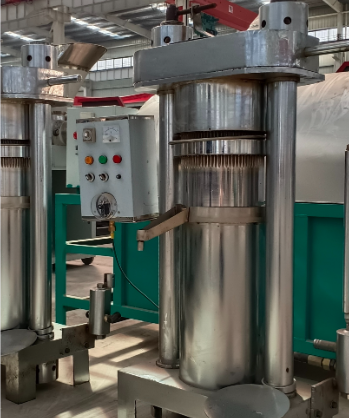
II. Structure of the High-Speed Hydraulic Sesame Oil Press
The sesame oil press mainly consists of three parts: 1. Main Body; 2. Hydraulic Transmission System; 3. Electrical Control System. These are described in detail below:
1. Main Body: This part comprises a base plate, columns, upper plate, pressing chamber assembly, oil receiving tray, nuts, etc., and is one of the main components of the machine. The oilseeds are pressed within the pressing chamber assembly and propelled upwards by the force of the hydraulic cylinder assembly. The oil flows down from the oil flow gap in the pressing chamber, through the oil receiving tray, and into the oil storage tank.
2. Hydraulic Transmission System: This is the main power source for the machine’s high oil yield. It consists of a drive shaft, worm gear, worm shaft, gear pump, high-pressure pump, overflow valve, manual control valve, hydraulic cylinder assembly, pipe joints, etc. This machine uses a world-class hydraulic pump station—a Korean three-plunger pump station. Compared to domestic two-plunger pumps, it has a lower speed, higher oil pressure, and is more resistant to high temperatures. It can operate continuously at oil temperatures above 65 degrees Celsius without a cooling device.
3. Electrical Control Section: This is where the machine excels. It consists of a motor, voltmeter, temperature controller, pressure gauge, power fuse, and other components.
III. Performance and Features of the High-Speed Hydraulic Sesame Oil Press:
1. The machine is small in size, occupies little space, is easy to learn, understand, and operate, and requires no special operator skills.
2. The machine consumes little electricity and incurs low costs during operation.
3. Compared to a stone mill, it saves 50% on electricity.
4. This machine is a hydraulic press, with high pressure, high oil yield, and good oil quality.
5. The machine adopts a fully automatic control system, with automatic preheating temperature control and hydraulic system pressure control.
6. The main components of the machine are made of imported high-quality silicon manganese steel, processed using CNC precision lathes and modern high-tech methods, resulting in excellent overall machine performance.
IV. Assembly Procedure for the High-Speed Hydraulic Sesame Oil Press Main Unit
1. After assembling the base plate and columns, place it in the designated location.
2. Clean the base. Install the oil cylinder on the base plate, ensuring the cylinder inlet faces the rear during installation. 3. When installing the oil receiving pan, the material cylinder fixing brackets on both side columns must be above the oil receiving pan.
4. Place the lower pad and perforated plate on top of the oil pan.
5. When installing the cylinder, prevent damage to other connecting parts.
6. After installing the top plate, tighten the nuts. When tightening the nuts, use a special tool to tighten them. After tightening, loosen 1/4 turn and tighten the bolts.
7. Tighten the left-side nut and install the top plate bracket on the bolt.
8. Connect the material cylinder bracket on the upper side of the oil receiving pan to the reinforcing ring B and secure it with bolts.
9. The pump box outlet pipe must be securely connected to the inlet.
10. Connect the heater power supply and the control circuit simultaneously.
11. When the power supply is 380V, connect the 2P wire in the electrical box to the 220V power supply and the 3P wire to the 380V power supply.
12. After assembly, add the prepared hydraulic oil. 13. After adjusting the motor rotation direction, attach the V-belt.
V. Operating Procedures for the High-Speed Hydraulic Sesame Oil Press
1. Connect the power supply: (If using a three-phase power supply, connect a single-phase 220V power supply simultaneously.)
2. In spring, autumn, and winter, connect the heating power supply (60-90 degrees Celsius). In summer, connect the heating power supply (50-70 degrees Celsius).
3. Open the top plate of the main unit and place the filter pad inside.
4. Place the roasted oilseeds inside.
5. After placing the filter pad inside, replace the top plate. (Do not place hard objects such as hammers inside.)
6. Place the top plate in place and replace the top plate.
7. Turn the operating switch to the automatic position and press the operating button to start operation. (If the control lever is in the unloaded position, the main unit piston will not work.)
8. After the machine is operating normally, the main unit starts pressing oil. When the pressure gauge reaches 60 MPa, the pump stops, and the pressure gauge drops. When the gauge reaches 54 MPa, the pump automatically starts again. When it reaches 60 MPa, the pump automatically stops again. This process repeats several times, with the start-stop intervals becoming increasingly longer. When oil drips from the bottom of the barrel every 3-4 seconds, the pressing is complete.
9. After pressing, press the pump stop switch and pull the control lever. When a gap forms between the main unit’s top plate and the column, open the top cover and simultaneously push the control lever to stop unloading.
10. Press the start button. The main unit starts working, and the oil cake begins to rise. After the oil residue is removed from the barrel, the machine stops. Remove the oil cake to complete one operation.
11. Sesame seeds, almonds, and other oilseeds should be thoroughly roasted and completely smoked before pressing.
12. This equipment is not recommended for oilseeds with high oil content, such as pine nuts. If it must be used, place them in the barrel using a special cloth. VI.
Precautions for High-Speed Hydraulic Sesame Oil Press
1. After adding the oilseeds, replace the top plate.
2. Ensure the top plate is completely in place before connecting the power supply.
3. If the pressure gauge does not read the pressure after the pump starts working, open the oil tank cover and first adjust the overflow valve cover of the large plunger pump (the one with the hexagonal screw in the middle). When the pressure gauge reads 40 MPa, indicating the system is working normally, adjust the overflow valve covers of the two smaller pump cores on both sides. The system should then operate normally when the pressure gauge reads 60 MPa. If any abnormalities occur (such as severe vibration or loud noise), stop the machine and check if the hydraulic system’s fixing screws are loose or if there are any oil leaks in the pipelines. Tighten the screws or replace the packing.
4. After removing the cake oilseeds, empty the container before cleaning the oil residue.
5. Release the internal pressure when removing the oil residue.
6. If the power switch is not working, check the power supply.
7. If the piston rises slowly, check the motor rotation direction.
8. If the power supply is normal, but the main unit does not pressurize after pressing the start button, open the oil tank cover, remove the one-way valve assembly, clean the spring and valve needle inside, and reinstall it.
9. If the pressure gauge pointer does not rise after pointing to 20-40 MPa, open the oil tank cover and check for oil leaks. If leaks are found, replace the packing.
10. If the pressure gauge reading exceeds 40 MPa and the large pump core continues to work without overflowing, or if the pressure gauge reading exceeds 60 MPa and the two small pump cores continue to work without overflowing, open the oil tank cover and rotate the corresponding hexagonal nuts (overflow valve covers) in the reverse direction.
11. Before testing, the user must reliably ground or connect to neutral according to local power grid regulations. The grounding resistance should be less than 4 ohms, and the conductor cross-section should be greater than 6 square millimeters. During operation, no one other than the operator is allowed to touch the equipment.
Post time: Feb-15-2026