

As a tropical oil-bearing crop, the extraction of oil from palm kernels requires a balance between efficiency and quality. Fully automatic screw palm kernels oil presses utilize a mechanical pressing process to separate oil from palm kernels while retaining certain nutritional components, making them well-suited for small to medium-scale oil processing operations. Their core design—focused on achieving high oil yield, low residual oil content, and stable operation—has established them as an essential category of modern oil processing equipment.
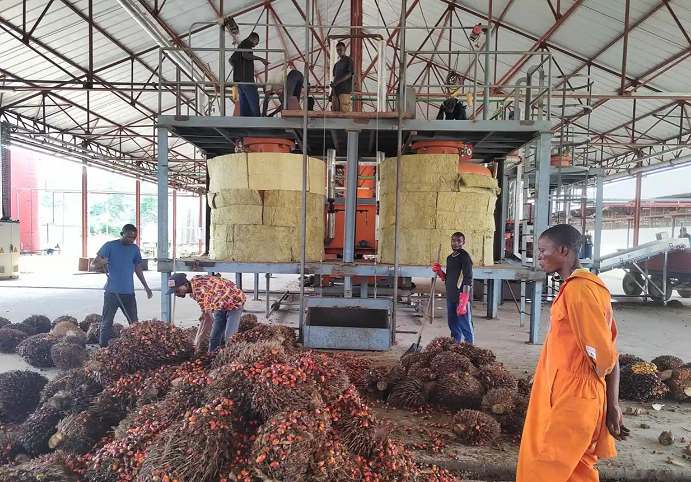
I. Technical Principles and Core Structure:
This equipment employs screw-extrusion technology, in which a rotating screw applies progressive pressure to palm kernels within a pressing chamber. After entering through the feed inlet, the material undergoes pretreatment—including preheating, softening, and the separation of kernels from shells—before reaching the pressing zone. As the gap between the screw and the chamber narrows, a 7.5kW power system (driven by a 380V power supply) facilitates continuous compression. The oil is expressed through gaps in the pressing chamber and collected after passing through a filter screen. The residual oil content in the dry cake is kept below 6%, ensuring an oil extraction rate of up to 94%. The main body is constructed from stainless steel to prevent metal contamination and extend the equipment’s service life.
II. Key Parameters and Performance:
With a processing capacity of 500 kg/h and a screw rotation speed of 18 RPM, the equipment strikes an optimal balance between pressing efficiency and oil quality. A dual-power configuration—supporting either a diesel engine or an electric motor—allows for flexibility across different power supply environments. Its dimensions (1500 × 800 × 1200 mm) facilitate seamless integration into automated production lines. The process relies entirely on physical compression, requiring no chemical additives and meeting food safety standards. A one-year warranty covers core components, mitigating risks associated with long-term use.
III. Operational Procedures and Safety Protocols:
Before operation, verify the stability of the power supply voltage and ensure the pressing chamber is free of foreign objects. Once started, feed the material evenly into the inlet to prevent clogging. During the pressing process, monitor the flow rate at the oil outlet; if the flow becomes abnormal, pause operation to inspect the screw for wear. The equipment is equipped with an automatic temperature control system, which maintains the palm kernels at an optimal pressing temperature (typically 50–60°C), thereby minimizing the loss of heat-sensitive components. After operation, any residual oil dregs must be cleared from the filter screens to prevent oxidation and spoilage.
IV. Application Scenarios and Customization Support:
This equipment is primarily designed for palm kernel processing enterprises, though it can also be adapted for pressing other hard oil-bearing materials, such as coconuts or walnuts. Customization options are available—for instance, the length of the pressing chamber can be adjusted to accommodate raw materials with varying oil content, or a kernel-shell separation module can be added to enhance pre-processing efficiency. Automated production line configurations can integrate auxiliary equipment, such as conditioning vessels (softening cookers) and filtration units, enabling a one-stop production process from raw material to finished product. For customized solutions, please discuss the specific characteristics of your raw materials and your production capacity requirements in advance to ensure that the equipment parameters are precisely matched to your actual operating conditions.
Post time: Nov-03-2026