

The core task of rice dryers and paddy drying equipment is to reduce the moisture content of newly harvested paddy to meet safe storage standards. The moisture content of new paddy is typically between 20% and 30%, while the ideal moisture content for long-term storage is approximately 13% to 15%. If natural drying is limited by weather or site constraints, mechanical drying becomes a crucial means of ensuring grain quality and reducing mold loss. This type of equipment reduces moisture by controlling the hot air temperature, airflow, and drying time, allowing moisture to migrate from the inside of the paddy to the outside, while simultaneously preventing grains from bursting or deteriorating in quality due to excessively high temperatures.
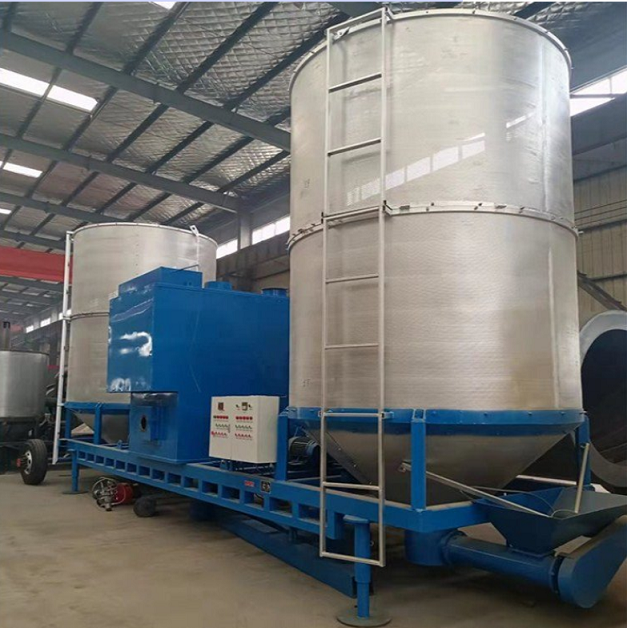
From a working principle perspective, paddy drying is a heat and mass transfer process. The equipment typically uses a vertical or tower structure. The paddy enters from the top and flows slowly downwards under gravity, coming into contact with hot air flowing upwards or laterally through the grain layer. The hot air heats the surface of the paddy, causing surface moisture to evaporate; simultaneously, moisture inside the paddy migrates to the surface driven by temperature and humidity gradients, resulting in continuous drying. The drying medium is typically heated air, which can be heated by electricity, coal, natural gas, or biomass, depending on the user’s energy costs and environmental requirements. The fan in the equipment provides sufficient airflow to ensure adequate contact between the hot air and the rice grains, and to remove evaporated water vapor. Moisture reduction is a key parameter, representing the percentage of moisture content reduction achieved in a single pass. For example, a 10% reduction means that rice with a 30% moisture content can be reduced to approximately 20% after one drying cycle. However, in actual production, multiple cycles or tempering processes are often required to avoid excessive internal stress in the grains.
In the industry, the design differences in rice drying equipment mainly lie in the drying structure and tempering process. Vertical dryers are widely used in farms and by farmers due to their small footprint and large processing capacity. The use of stainless steel in the equipment is primarily for corrosion resistance and ease of cleaning, as rice releases dust and moisture during the drying process, and prolonged contact can corrode the metal. Rotation speed and total power reflect the equipment’s processing capacity and energy consumption level. The rotation speed is controlled at approximately 86 revolutions per minute to ensure a moderate residence time for the rice within the machine—neither too fast (leading to insufficient moisture) nor too slow (affecting efficiency). The automated operation design allows users to set the hot air temperature and drying time through the control system, reducing manual intervention and improving drying uniformity. It is worth noting that different heating methods directly impact drying quality and operating costs: electric heating offers precise temperature control but has higher operating costs; coal or biomass heating has lower costs but requires dust removal equipment to meet environmental requirements.
In practical applications, the selection of rice drying equipment needs to be comprehensively considered in conjunction with local climate, initial moisture content of the rice, and drying scale. In rainy southern regions, the moisture content of harvested rice is often high, requiring equipment with strong moisture-reducing capabilities and continuous operation. In this case, large-scale equipment (e.g., 10-ton capacity) and designs compatible with multiple heating methods are more advantageous. For small farms or individual farmers, mobile or smaller equipment (e.g., 3-ton or 5-ton) is more flexible and can meet the needs of small-batch, multi-batch drying. Furthermore, the tempering process during drying is crucial: rice needs time to redistribute its internal moisture after heating; otherwise, direct cooling or secondary drying can easily cause the grains to crack. Therefore, many dryers are designed with a built-in tempering section or recommend intermittent drying during operation. Understanding these principles and industry practices helps users configure equipment appropriately based on their own conditions to achieve efficient and low-loss grain drying.
Post time: Sep-07-2026