

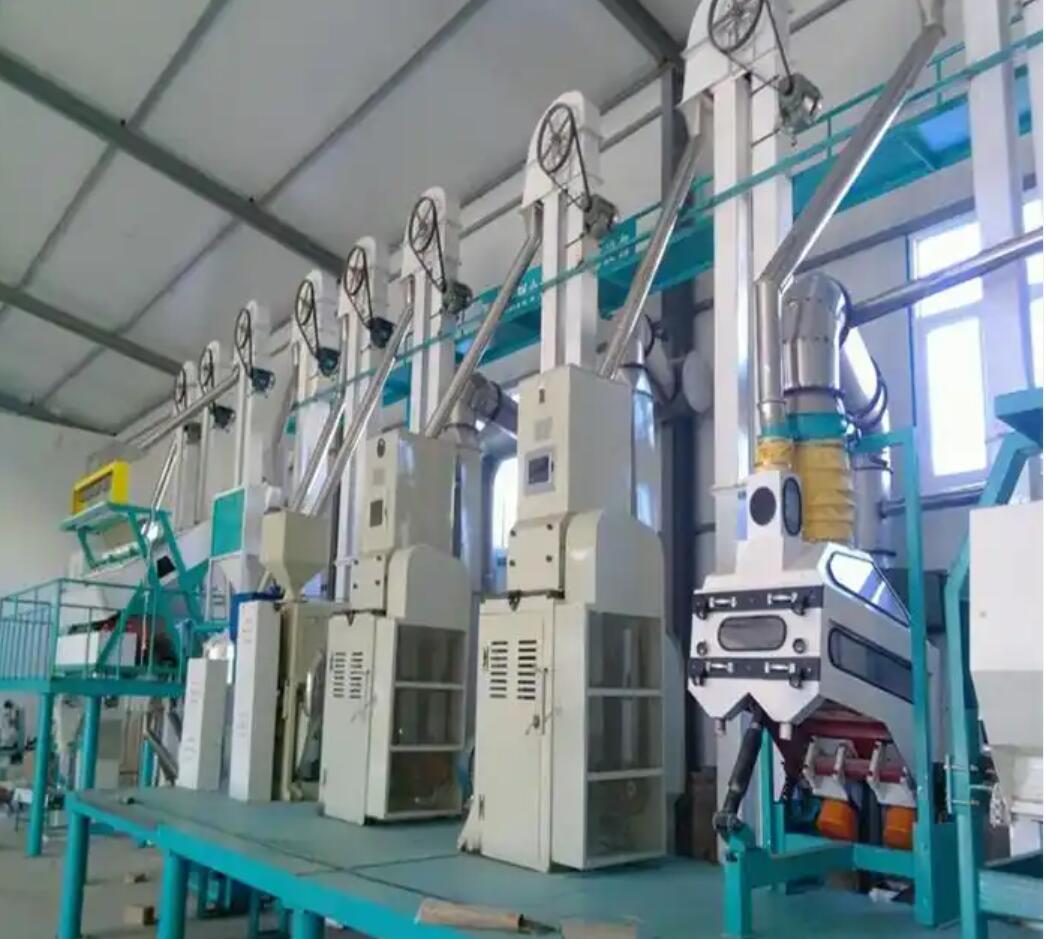
A complete rice milling production line is an important piece of equipment in the modern grain processing industry, widely used in the hulling, peeling, polishing, and grading of paddy rice. With the development of agricultural mechanization and the grain processing industry, the technology of complete rice milling machines has been continuously upgraded, significantly improving automation and production efficiency to meet the demands of large-scale industrial production and the high-quality rice market. This article will detail the operating principle and main components of a complete rice milling production line.
I. Basic Components of a Complete Rice Milling Production Line
A complete rice milling production line typically consists of several key pieces of equipment, including cleaning equipment, hulling machines, rice hullers, brown rice separators, rice milling machines, polishing machines, color sorters, white rice grading sieves, and a finished product packaging system. These devices work together to achieve the entire processing process from raw grain to finished rice.
1. Raw Grain Cleaning System
Before entering formal processing, paddy rice first needs to undergo cleaning. The cleaning system mainly includes equipment such as vibrating screens, destoners, and magnetic separators. Its function is to remove impurities such as sand, metal particles, and straw from the paddy rice to ensure the safe operation of subsequent equipment and the quality of the finished rice.
2. Hulling and Rice Hulling Process
The cleaned paddy rice enters the hulling machine (also called a rice huller). Through the friction between rubber rollers or diamond rollers, the outer husk of the paddy rice is separated from the grain. The hulled material is brown rice, which still contains some unhulled paddy rice. Therefore, it needs to be separated from the unhulled grain by air separation or gravity separation equipment.
3. Brown Rice Whitening
Brown rice contains a large amount of bran and germ, resulting in a rough texture. Although it is high in nutrients, it does not conform to popular consumption habits. Therefore, it needs to be whitened by a rice milling machine. Rice milling machines are divided into two types: iron roller rice milling machines and sand roller rice milling machines. Through the friction and compression between the high-speed rotating rollers and the rice grains, the bran layer on the surface of the rice grains is removed, turning it into white rice. 4. Polishing and Color Sorting
To improve the appearance and storage performance of rice, the milled rice undergoes polishing. During polishing, residual bran powder on the surface of the rice grains is further removed, and a small amount of water mist or starch solution is sprayed to make the rice grain surface smoother and shinier. Subsequently, a color sorter is used to screen the rice by color, removing yellow grains, moldy grains, and other discolored grains to ensure that the finished rice has a consistent color and excellent quality.
5. Grading and Packaging
Finally, the polished and color-sorted rice enters a white rice grading sieve, where it is classified according to grain size. Then, an automatic weighing and packaging system completes the bagging, sealing, and labeling processes, ultimately forming finished rice ready for market.
II. Advantages and Features of Complete Rice Milling Machines
High Efficiency and Energy Saving: Modern complete rice milling machines adopt advanced power transmission systems and energy-saving motors, resulting in low overall energy consumption and high production efficiency.
High Degree of Automation: The entire production line can be controlled by PLC, making operation simple, reducing manual intervention, and improving production stability.
Superior Finished Product Quality: Multiple meticulous processing steps ensure the rice is white in color and has a delicate taste, meeting national grain and oil quality standards.
Environmentally Friendly and Safe: Equipped with dust collection devices and noise reduction design, reducing environmental pollution and protecting the health of operators.
Wide Applicability: Production lines with different capacities can be customized according to customer needs, suitable for various application scenarios such as large processing plants, small and medium-sized rice mills, and rural cooperatives.
III. Conclusion
Complete rice milling machinery production lines, as core equipment in modern grain processing, are continuously developing towards intelligent and green directions. FOTMA MILL, as a professional grain and oil machinery equipment manufacturer, is committed to developing efficient, energy-saving, and environmentally friendly rice milling equipment, providing one-stop services from process design to installation and commissioning, and is deeply trusted by customers. Choosing high-quality rice milling machinery can not only improve enterprise production efficiency but also ensure product quality, giving you a competitive edge in the fierce market competition.
Post time: Aug-08-2026