

This paper aims to explore the process flow and working principle of a new flour mill, focusing particularly on how to improve processing quality and efficiency through process parameter optimization. Based on current technological development and market research data, this paper analyzes the equipment price range for flour production lines of different scales, aiming to provide scientific guidance for researchers and practitioners in related industries.
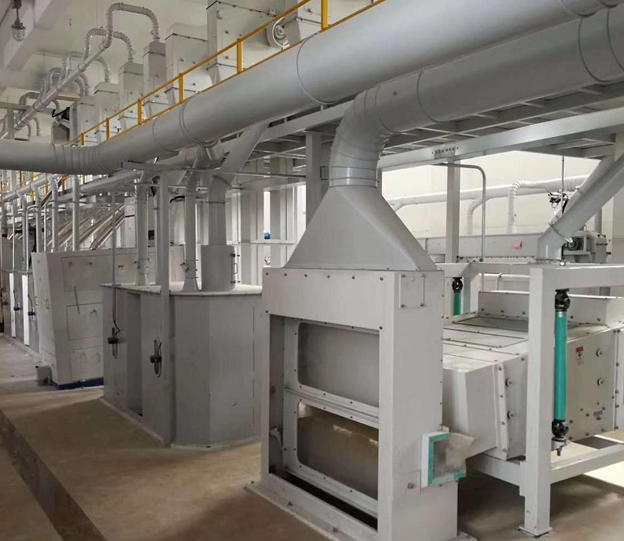
Introduction Flour, as an important component of daily diet, directly affects food quality. Traditional flour processing methods often suffer from low production efficiency, high energy consumption, and unstable product quality. With technological advancements, new flour mills have emerged, not only improving production efficiency but also significantly enhancing flour quality. To better understand and apply these new technologies, this study starts with the process flow and working principle, exploring key process parameter optimization strategies.
1. Process Flow
The workflow of the new flour mill mainly includes the following steps:
1. Raw Material Preparation: First, raw materials such as wheat are screened, washed, and soaked to remove impurities and soften the raw materials.
2. Grinding: The processed raw materials are fed into a flour mill for grinding. This process typically involves multiple stages, each using a specific grinding disc configuration for optimal results.
3. Sieving: The ground material is sieved through a series of screens with different apertures to separate flour into different particle sizes.
4. Cooling and Packaging: The sieved flour needs to be cooled to prevent quality degradation due to excessive temperature, and finally packaged and stored.
2. Working Principle
The working principle of the new flour mill is primarily based on physical and mechanical action. Specifically, it applies pressure to the raw materials through high-speed rotating grinding discs, thereby achieving fine grinding. Furthermore, by adjusting parameters such as the gap between the grinding discs and the rotation speed, the particle size distribution of the flour can be effectively controlled, thus affecting the quality of the flour.
3. Process Parameter Optimization
To further improve flour quality and production efficiency, precise control and optimization of process parameters are essential. The following are key points to focus on during optimization:
- Grinding disc gap: A reasonable grinding disc gap ensures that the material is fully ground without over-grinding, resulting in an ideal flour particle size distribution.
- Rotation speed: Appropriate rotation speed not only improves grinding efficiency but also reduces energy consumption and extends equipment lifespan.
- Temperature control: Strict temperature control during the grinding process prevents flour spoilage caused by high temperatures.
- Feed rate: Properly adjusting the feed rate ensures the uniformity and continuity of each batch, contributing to improved production efficiency.
Equipment Cost Analysis
According to market research data, the price range for flour production line equipment of different scales is as follows:
- Small production line equipment (suitable for home or small businesses): Approximately RMB 150,000 to 250,000.
- Medium-sized production line equipment (suitable for small and medium-sized processing plants): Approximately RMB 250,000 to 1,000,000.
- Large production line equipment (suitable for large-scale production): Approximately RMB 1,000,000 to 1,500,000.
Conclusion
The new flour mill, through its advanced process flow and working principle, significantly improves flour processing quality and production efficiency. Precise control and optimization of process parameters can further enhance product competitiveness. Future research should focus more on balancing technological innovation with cost-effectiveness to meet the growing market demand.
Post time: Feb-06-2026