

How Does a Screen Make Rice “Automatically Queue Up”?
The rice grader may seem simple, but it’s a crucial element in rice processing plants, determining the yield and quality of the finished product. It utilizes the size and shape differences between whole rice grains, allowing them to overlap layer by layer on a rotating screen surface. Friction propels the grains forward, creating a natural, automatic grading flow. Continuous multi-layered screens separate broken rice, medium-broken rice, and whole rice in sequence, ultimately producing four distinct grades: premium rice, first-grade rice, large broken rice, and small broken rice—even the same batch of paddy can be graded to different levels of value.
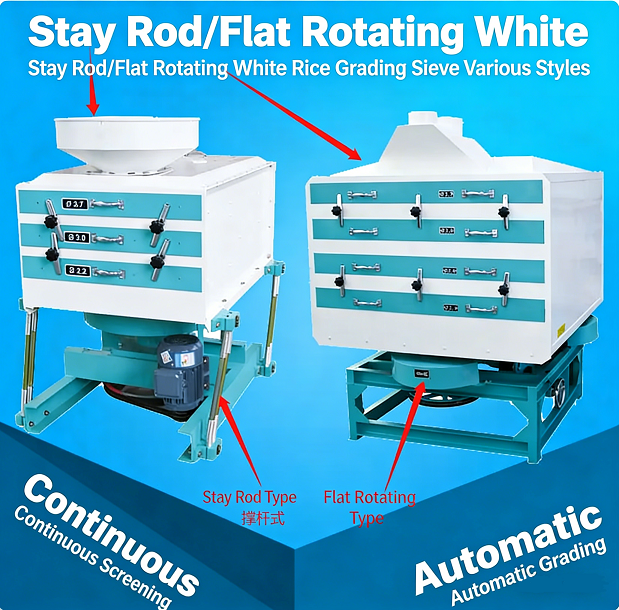
Support-Type VS Flat Rotating Type Rice Grader: Two Structures, Two Applications
The 63×3 and 80×3 sizes are mostly support-type, with a compact structure and moderate inlet width, suitable for small to medium-sized plants with a daily output of several hundred tons.
100×3 and above models feature a flat-rotating screen with a wider sieve surface and greater thrust, pushing whole rice grains further while trapping fine impurities at the front. Suitable for high-end rice noodles, pre-washed rice, and other applications requiring extremely high cleanliness.
63×3 Standard Model: One Machine Handles Large, Medium, Small, and Broken Rice
Adjustable sieve height allows for the separation of large, medium, small, and broken rice streams in a single output.
Standard configuration includes 3.0/2.8/2.6 mm three-layer sieves; 2.2/3.5 mm sieves are optional to meet different particle size requirements.
The machine includes a frame, distributor, and dropper pipe; its 70 cm height optimizes both human-machine operation and factory space.
80×3 Upgraded Model: Larger Imported Frame for More Stable Buffering
Dimensions: 145×100×140 cm; driven by a 0.75 kW six-pole motor, resulting in lower speed and longer lifespan.
No feeding hopper is needed; the inlet is directly located on the side of the machine body, and it has a built-in buffer chamber, allowing for continuous feeding without clogging from the moment it’s turned on.
Standard configuration includes a 3.0/2.8/2.2 mm three-layer screen, weighing 442 kg. It can be moved by one person, making maintenance simple.
Post time: Apr-03-2026