

Within the rice processing value chain, rice hullers and rice whiteners fulfill the core, specialized roles of de-hulling and fine milling, respectively. These two types of machinery exhibit fundamental differences in terms of functional positioning, technical principles, and equipment parameters.
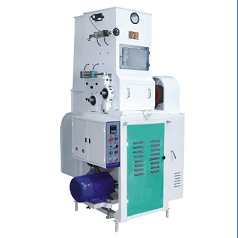
In terms of functional positioning, the rice huller serves as the initial processing stage; it achieves the removal of rice husks through the differential friction generated by rubber rollers. It boasts a de-hulling rate exceeding 85% and a brown rice breakage rate of less than 2%, yielding semi-finished brown rice that retains its bran layer and germ. The rice whitener, conversely, is responsible for the fine-finishing stage; it employs abrasive rollers or iron rollers to mill away the bran layer. Modern models utilize composite technologies to boost the germ retention rate to 80% and are equipped with temperature control systems to ensure the temperature within the whitening chamber remains at or below 40°C, thereby preventing the loss of Vitamin B1.
Regarding technical principles, the rice huller relies on the frictional force generated by a 20% rotational speed differential to effect de-hulling, and it is paired with an air-separation system to achieve a separation efficiency exceeding 95%. Rice whiteners diverge into three distinct technical pathways: abrasive-roller models utilize high-speed cutting action to achieve rapid bran removal; iron-roller models employ low-speed rolling pressure to keep the broken rice rate at or below 3%; and flexible rice whiteners utilize a layered milling technique to reduce the broken rice rate for long-grain Indica rice to 7.9%, while simultaneously lowering energy consumption by 37.1%.
A comparison of equipment parameters reveals that the rice huller operates with a core differential speed of 960–1200 rpm; it has no mandatory temperature control requirements, produces brown rice retaining its bran layer, and exhibits a typical energy consumption of 0.55 kW·h/kg. The rice whitener operates with a synchronous speed of 800–1200 rpm; it requires strict temperature control to maintain the whitening chamber at or below 40°C, ultimately yields white rice with a residual bran layer thickness of 0.1 mm or less, and—depending on the specific model—has an energy consumption ranging from 7.3 to 14.9 kW·h/t.
In terms of practical application scenarios, the selection of a rice huller must be carefully matched to the specific rice variety being processed and the required de-hulling efficiency; for instance, processing the “Nongxiang 42″ rice variety necessitates the use of equipment capable of achieving a de-hulling rate exceeding 98%. The selection of rice milling machinery must be aligned with the product’s market positioning: traditional models are suitable for the *Japonica* rice varieties found in northern regions, whereas *Indica* rice varieties—prevalent in the south—prioritize the use of “flexible” milling machines. For the high-end market, equipment featuring intelligent temperature control is essential to ensure a Vitamin B1 retention rate exceeding 90%.
Technological evolution in this field is characterized by two major trends: the integration of hulling and milling processes, and the application of digital twin control systems. Combined hulling-milling units achieve full-process automation through equipment integration, attaining an overall efficiency of 92%. Flexible milling machines, powered by AI algorithms, limit the temperature rise of the rice to within 5.2°C—a 45% reduction compared to traditional models. Equipment selection recommendations should be differentiated based on production capacity: small-scale workshops are best served by combined hulling-milling units, high-end production lines require intelligent temperature-controlled equipment, and *Indica* rice processing operations must specifically verify the functionality of layered grinding. Precisely matching equipment parameters with product requirements is the key to optimizing processing workflows and controlling costs.
Related products of this article: PADDY HUSKER , RICE WHITENER

Author: Ms. Danni, over 20 years of experience in the field of grain and oil machinery.
Post time: Mar-28-2026