

In the rice processing industry, users often prioritize equipment throughput and rice yield, equating “high output and high yield” with quality machinery. However, the factors that truly determine long-term profitability extend far beyond these two metrics. Consider a complete processing system with a daily capacity of 150 tons: it features a processing rate of 400–500 kg/h, an 80% finished product yield, and a total power rating of 514 kW. Underlying these specifications is a comprehensive process chain design covering everything from paddy cleaning, husking, and milling to final product finishing. Differences in milling methods, bran separation precision, and the flexibility to switch between brown rice and germ rice production are the critical factors determining whether a processing enterprise can adapt to market shifts and control operating costs.
Analysis of Working Principles and Core Structure
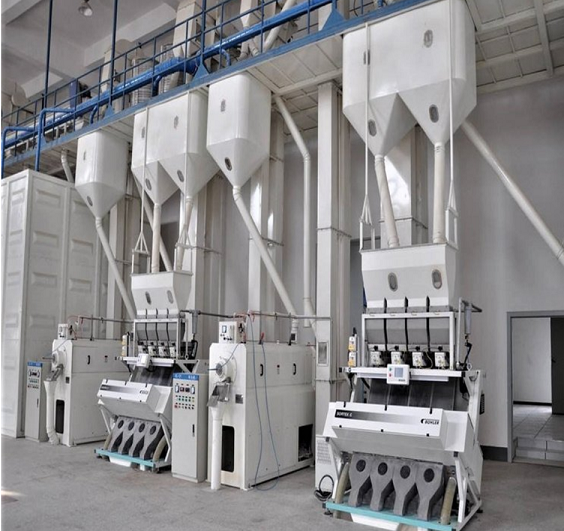
The core logic of a complete rice processing system is “multi-stage, gentle milling” to remove outer layers gradually. Paddy rice first undergoes a cleaning process to remove impurities before entering the husker to produce brown rice. The brown rice then passes through multiple milling machines to progressively remove the outer layers, ultimately resulting in polished white rice or fresh rice with the germ intact. The system’s ability to produce brown rice, germ rice, or fresh rice at will implies an adjustable milling pressure and depth design, allowing operators to fine-tune process parameters based on the target product. For instance, producing germ rice requires lower milling intensity to preserve the rice germ, whereas producing polished white rice necessitates increasing the number of milling stages. The 514 kW power rating indicates a line comprising multiple motor-driven units—such as elevators, huskers, milling machines, polishers, and color sorters—where power distribution across stages must align with material flow rates. A modular design supported by a steel framework facilitates installation and maintenance. A 150-ton/day capacity implies continuous production; therefore, the process layout must ensure stable material flow between stages to prevent blockages or idle running.
How Technical Differences Affect Practical Application
Technical differences among rice processing machines primarily manifest in the structural type of the milling unit (vertical vs. horizontal; abrasive roller vs. iron roller), the configuration of air separation and color sorting systems, and the level of automation.
Abrasive roller mills exert strong milling force, making them suitable for producing highly polished white rice; however, they cause rapid grain temperature rise, which can compromise rice quality. Iron roller mills remove the bran layer through friction, making them better suited for producing germ rice or rice with the germ retained, though their efficiency is relatively lower. The equipment’s ability to process brown rice, germ rice, and fresh rice suggests a modular milling design or the use of interchangeable milling rollers. The 80% yield rate is a composite figure influenced by raw grain moisture, impurity content, and the required degree of milling. In actual production, aiming for higher precision (e.g., polished white rice) increases the broken rice rate and may drop the yield below 75%, whereas relaxing precision requirements (e.g., brown rice or germ rice) can push the yield close to 85%. A 514 kW power rating implies high electricity consumption for the entire line, requiring enterprises to calculate the electricity cost per ton of rice. A one-year warranty in a continuous industrial operation context means users must stock their own wear parts or sign extended service agreements.
Application Scenarios and Framework for Understanding
To determine if this equipment meets your needs, consider the following dimensions:
First, focus on process flexibility—does the equipment support switching between product varieties (e.g., brown rice, germ rice, polished white rice)? What parameters require adjustment during switching, and what are the associated time costs and material losses?
Second, evaluate the energy-to-output ratio—given the 514 kW power configuration, what is the actual electricity consumption per ton of rice, and is long-term operation economically viable at local electricity rates?
Third, consider raw grain adaptability—the 400–500 kg/h processing capacity is a nominal figure; actual throughput depends on the rice variety and moisture content, as high moisture or high impurity levels will reduce effective throughput.
Fourth, understand yield fluctuations: while 80% serves as a reference figure under ideal operating conditions, actual production requires dynamic adjustments based on the target product type and raw material quality; enterprises should establish their own models to balance quality and loss.
By considering these factors, processing enterprises can make more rational assessments of whether their equipment configuration aligns with their product positioning, raw material sources, and operational cost expectations.
Post time: Oct-10-2026