

As core equipment in the grain processing industry, the safe operation of wheat flour milling equipment directly affects production efficiency, product quality, and the safety of operators. With the large-scale and intelligent development of my country’s flour processing industry, ensuring the safe and stable operation of equipment has become a key focus of the industry. This article will systematically elaborate on the fundamental elements for ensuring the safe operation of wheat flour milling equipment from five dimensions: equipment selection, installation and commissioning, daily maintenance, operating procedures, and emergency handling.
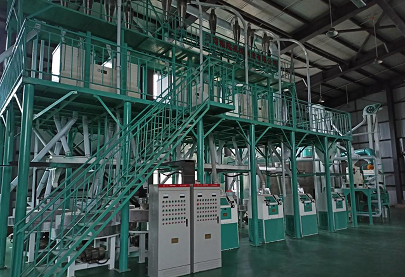
I. Scientific Selection is a Prerequisite for Safe Operation
Equipment selection needs to comprehensively consider the processing scale, raw material characteristics, and process requirements. According to industry practice, medium and large-scale production lines with a daily wheat processing capacity of over 100 tons should adopt a “three-screening, two-beating, two-destoning” cleaning process combined with an eight-roll milling solution. This configuration can effectively reduce the risk of equipment overload.
II. Professional Installation and Commissioning Builds a Safety Line
During the installation phase, strict adherence to GB/T 37400.15-2019 General Technical Conditions for Heavy Machinery is required. The foundation concrete curing period must be no less than 28 days, and the levelness deviation must be controlled within 0.1mm/m.
III. Preventive Maintenance System Ensures Long-Term Operation
Establishing a three-level maintenance system is crucial. Daily maintenance includes bearing lubrication every shift (ISO VG68 food-grade lubricating oil is recommended) and checking the transmission belt tension (deflection controlled within 12-15mm); weekly maintenance should focus on cleaning the pulse dust collector filter cartridge (replace immediately if resistance exceeds 1200Pa); monthly maintenance requires checking the grinding roller runout (no more than 0.05mm).
IV. Standardized Operating Procedures Eliminate Human Risks
Operators must be certified and strictly adhere to the “three confirmations” system: confirm the protective devices are intact before starting the machine, confirm the parameters are stable during operation, and confirm energy isolation after shutdown. Key operational points include: Feed flow rate should be controlled within 80-90% of rated capacity to avoid overload operation; when adjusting the rolling gap, it must be loosened first and then tightened, with each adjustment not exceeding 0.05mm; in the event of a sudden power outage, the air circuit valves should be immediately shut off to prevent cylinder malfunction.
V. Systematic Emergency Response Mechanism to Reduce Accident Losses
A comprehensive emergency plan should include procedures for handling 16 common faults. When abnormal vibration occurs (acceleration exceeding 7.1m/s²), the three steps of “speed reduction-feed reduction-shutdown” should be executed immediately; when signs of dust explosion occur (sudden temperature rise accompanied by pressure fluctuations), the nitrogen protection system must be activated within 3 seconds.
With the application of IoT technology, the new generation of flour processing equipment is developing towards predictive maintenance. By collecting data through intelligent terminals such as vibration sensors and thermal imagers, combined with big data analysis, more than 85% of potential faults can be predicted 72 hours in advance. However, no matter how advanced the technology, strengthening the foundation of safety management remains fundamental to ensuring the stable operation of equipment. Enterprises should continuously improve their safety management systems, strengthen personnel training, and build a safety assurance system covering the entire life cycle of equipment in order to achieve high-quality and sustainable production goals.
Post time: Feb-16-2026