

When rinsing rice before cooking, have you ever found small stones, shriveled husks, or broken grains in your rice container? These seemingly insignificant impurities not only affect the taste but can also pose safety hazards. However, the plump, clean rice we buy today is thanks to a key piece of equipment—the flat rotary screen—that performs a “meticulous inspection.”
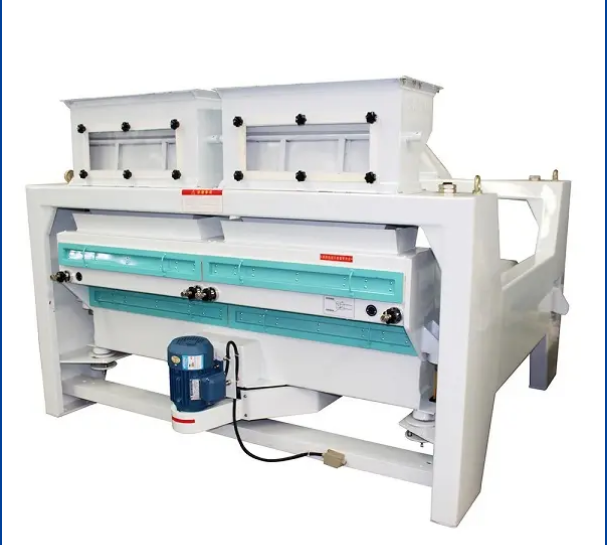
You might be unfamiliar with the name “flat rotary screen,” but it’s already deeply integrated into every stage of grain processing. Unlike the “up-and-down” sieving method of traditional vibrating screens, the core advantage of the flat rotary screen lies in its “smooth rotation”: driven by an eccentric shaft, the screen surface rotates horizontally. This motion avoids the violent vibrations that break up fragile grains like in a vibrating screen, while allowing the material to be evenly distributed on the screen surface, achieving more precise stratified screening.
Specifically, after freshly harvested rice is hulled into “brown rice,” it is fed into the inlet of a flat rotary screen. The screen surface typically consists of 2-3 layers, each with screens of different aperture sizes: the top layer has the largest aperture, primarily intercepting larger impurities such as rice husks and weeds; the middle layer separates broken rice that is not long enough to meet the standard, for use in the production of rice flour, rice bran, and other byproducts; the bottom layer allows only whole, uniformly sized, high-quality rice to pass through, ultimately becoming the staple food on our tables.
Even more ingeniously, the flat rotary screen is equipped with a “particle removal assistant”—a gravity grading device. Because impurities such as stones and metal shavings are much denser than rice, during the screen’s rotation, these heavier impurities are thrown to the edge of the screen by centrifugal force and then discharged through a dedicated discharge port. Actual test data from a grain processing plant shows that after using a planar rotary screen, the impurity removal rate of rice increased from 85% with traditional equipment to 99.5%, while the broken rice rate decreased from 10% to below 3%, reducing waste and significantly improving product quality.
Some might ask, “Isn’t it just sifting rice? Can’t we just use a simple sieve and do it manually?” The answer is clearly no. Modern grain processing has long entered a stage of large-scale production. A medium-sized processing plant processes tens of tons of paddy rice daily. Manual screening is not only inefficient but also prone to incomplete screening due to fatigue. A planar rotary screen, on the other hand, can process 10-30 tons of material per hour and can operate continuously for 24 hours, equivalent to the workload of dozens of workers, while ensuring consistent screening standards.
Besides grain processing, planar rotary screens also play an important role in food processing such as flour and starch. For example, in flour production, it can grade flour of different fineness, allowing for precise separation of high-gluten flour for bread making and low-gluten flour for cake making; in starch processing, it can remove protein particles from starch, improving starch purity.
Today, as people’s demands for food safety and quality increase, rotary screens are constantly being upgraded. Newer equipment incorporates an intelligent control system that uses sensors to monitor the screen’s working status in real time. If problems such as screen blockage or material accumulation occur, it automatically alarms and adjusts operating parameters. Some models also feature a fully sealed design to prevent dust generation during the screening process, protecting worker health and meeting environmental protection requirements.
Next time you enjoy a bowl of fragrant rice, consider this: those plump grains of rice may have undergone rigorous screening on a rotary screen before finally reaching your table. This seemingly ordinary machine, with its precision and efficiency, silently safeguards our food safety.
Post time: Mar-17-2026