

Color Sorter Working Principle Unveiled
I. How Color Sorters Identify Colors
The core of a color sorter lies in its “eagle eye”—a high-precision CCD sensor. After the material is evenly dispersed by the vibrating feeder, a high-speed camera takes a picture within 0.001 seconds, essentially giving each piece of material an “ID card.” The system compares this to preset color parameters and immediately marks any anomalies. Interestingly, modern color sorters can identify over 1000 color differences, making them more than 10 times more sensitive than the human eye.
II. Precise Control of Sorting Actions
Identification is only the first step; the key is how to quickly and accurately remove defective products. Color sorters use high-pressure airflow nozzles with a response time of only 5 milliseconds. When “problem material” passes through the sorting area, the computer precisely controls the corresponding nozzle to open, blowing the defective product into the waste trough. This process is like playing “whack-a-mole,” only 100 times faster than a human.
III. Adaptation Techniques for Different Materials
Not all materials are suitable for the same sorting mode. For regular grains like rice, transmission detection is better at identifying internal defects; while for irregular materials like tea leaves, reflection detection combined with 3D imaging technology is needed. Experience shows that adjusting the appropriate vibration frequency and sorting sensitivity can improve accuracy from 90% to over 99.5%.
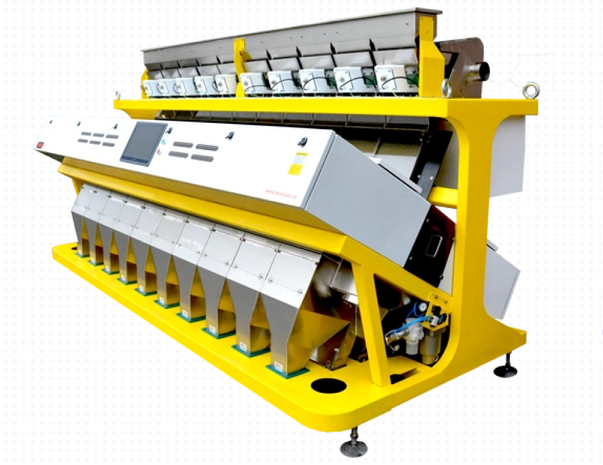
Color Sorter Capacity Unveiled
I. Core Indicators of Color Sorter Capacity
The hourly processing capacity of a color sorter typically fluctuates between 1 and 10 tons, depending on three key factors:
Number of Channels: A 64-channel model is 1.8 times faster than a 32-channel model.
Material Type: Regular grains like rice are 40% more efficient than mixed grains.
Sorting Accuracy: Reducing the defect rate from 5% to 1% will decrease capacity by 25%.
II. Three Variables Affecting Efficiency
Just as a mobile phone’s operating speed is affected by many factors, the actual output of a color sorter also varies dynamically:
Pre-treatment: Pre-cleaned materials can increase the throughput by 30%.
Photoelectric System: CCD phase… The machine is 3 times faster than traditional photocells in recognition speed.
Airflow intensity: For every 0.2MPa increase in air pressure, rejection efficiency increases by 15%.
III. Practical Techniques to Improve Production Capacity
Mastering these methods will make your color sorter “faster, better, and cheaper”:
Regularly calibrate the lens focal length to avoid duplicate sorting due to misjudgment.
Maintain stable vibration of the vibrating feeder to ensure uniform material passage.
Adjust parameters according to seasonal humidity; during the rainy season, it is recommended to reduce the conveyor belt speed by 10%.
Clean the optical lenses every 8 hours of operation to maintain a recognition accuracy of over 95%.
Color Sorter Debugging Guide
I. Equipment Inspection and Preparation
Before debugging the color sorter, ensure the equipment is in ideal condition. First, check if the power connection is secure to avoid equipment malfunctions due to unstable voltage. Second, clean the optical lenses and sensors to ensure no dust or stains affect recognition accuracy. Finally, confirm that the conveyor belt and sorting device operate smoothly without jamming or abnormal noise. These basic checks can effectively avoid common problems during debugging.
II. Parameter Setting and Adjustment
The core of the color sorter lies in parameter configuration. Adjust the light source intensity and camera sensitivity according to the material characteristics to ensure accurate recognition. For example, for materials with similar colors, the sensitivity can be appropriately increased to reduce false positives. Simultaneously, set an appropriate sorting speed to balance efficiency and accuracy. During debugging, start with a small number of samples for testing, gradually optimizing parameters until the ideal effect is achieved.
III. Effect Verification and Optimization After completing the parameter settings, actual sorting tests are necessary. Observe the sorting effect and record the false positive rate and missed positive rate. If problems are found, fine-tune the parameters or check the equipment status. Furthermore, regular maintenance and calibration of the equipment can extend its service life and maintain stable performance. Through repeated testing and optimization, the color sorter will gradually reach its optimal working state.
Post time: Mar-24-2026