

A color sorter is an intelligent “quality inspector” on a modern production line. Using photoelectric technology, it precisely sorts out particles of different colors, achieving an efficiency of several tons per hour and an accuracy exceeding 99.9%. From pure grains to resource recycling, it uses its “eagle eyes” to safeguard quality and drive industrial upgrading.
On modern production lines in agricultural product processing, food production, and even resource recycling industries, a type of equipment is playing an increasingly important role as a “quality inspector” and “sorter”—the color sorter. Many people, upon first encountering this term, have a fundamental question: What is a color sorter used for? Simply put, it is a high-tech device that uses photoelectric detection technology to automatically and quickly sort out particles or impurities of different colors from large quantities of raw materials based on differences in material color. Its existence greatly liberates manpower, improves sorting accuracy and efficiency, and is an indispensable key link in ensuring product quality.
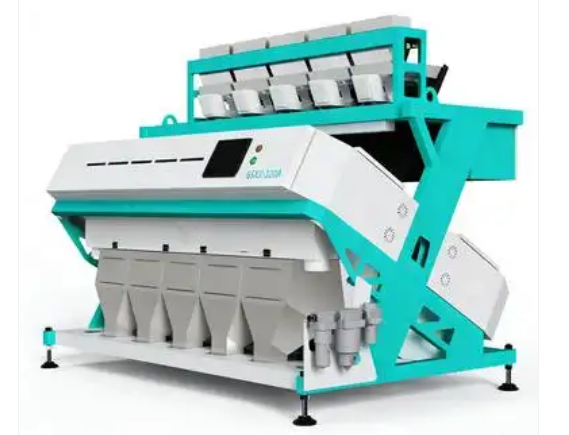
The working principle of a color sorter: Simulating and surpassing the human eye
To deeply understand what a color sorter is used for, it is necessary to analyze its core working principle. Traditional manual sorting relies on workers’ eyesight and physical strength, which is not only inefficient and costly, but also prone to errors due to fatigue, and hygiene conditions are difficult to guarantee. The design of color sorters is essentially a highly simulated and intelligently superior version of human visual judgment and manual sorting.
Their workflow can generally be summarized in several key steps: First, the materials to be sorted are evenly spread out by a vibrating feeder, forming a single-layer material flow, which then passes sequentially through a special optical detection area. Here, a high-definition camera or photoelectric sensor acts as the “eye,” scanning each material at high speed and capturing its color, shape, and even spectral information. Next, the system’s core—the intelligent image processing chip—this powerful “brain” instantly compares and analyzes the captured information against preset standard parameters. When it identifies discolored particles (such as moldy rice grains, pebbles, glass, plastic, or different varieties of coffee beans) that do not meet the requirements for color, gloss, or other characteristics, the “brain” quickly makes a judgment and issues instructions. Finally, the actuator (usually a jet nozzle controlled by a high-frequency solenoid valve) precisely positions itself and emits a stream of compressed air, accurately blowing the defective product away from the path of the normal material, thus achieving the physical separation of good and bad materials. The entire process is completed in an instant, seamlessly, precisely, and efficiently.
Wide Applications: From Field to Table, From Mine to City
Understanding what color sorters are used for reveals their far wider range of applications than many people imagine. They have already permeated many industrial chains closely related to our daily lives.
In the agricultural and food processing sector, they are the “guardians” of staple food safety. Whether it’s removing impurities from rice (removing yellow grains, moldy rice, stones, and barnyard grass), selecting fine grains (mung beans, red beans, soybeans), or grading tea (removing tea stems and yellow leaves) and nuts (peanuts, almonds), color sorters are relied upon to improve quality and commercial value. It can be said that the color sorter plays an indispensable role in ensuring that we can buy uniformly sized, pure, and safe grains in the market.
In the food industry, it acts as a gatekeeper for consistent quality. From sorting coffee beans and selecting dehydrated vegetables to removing impurities from dried seafood and removing burnt slices from potato chip production lines—processes requiring extremely high color consistency—are where color sorters truly shine.
In resource recycling and industrial sectors, it’s a magician turning waste into treasure. From separating different colored fragments from waste plastic bottles to separating transparent, green, and brown varieties from broken glass, and even from ores to preliminarily screen mineral particles of different compositions, color sorters, with their powerful color recognition capabilities, significantly improve the purity and value of recyclables, promoting the development of a circular economy.
Therefore, what is a color sorter used for? It’s not just a sorting machine; it’s a key technological piece of equipment for increasing product added value, ensuring consumer safety, and promoting efficient resource utilization.
Technological Evolution: From Color to Multispectral Intelligence
As technology continues to advance, the scope and capabilities of color sorters are constantly expanding. Early color sorters primarily relied on visible light color differences for judgment. Today, they have evolved into intelligent sorting platforms integrating multispectral analysis, artificial intelligence deep learning, and high-resolution imaging technologies.
For example, some advanced color sorters are equipped with near-infrared (NIR) or hyperspectral sensors, capable of detecting internal material composition information, such as moisture content, protein content, and even minute internal mold growths—detectable to the human eye and ordinary cameras. This allows color sorters to not only “select colors” but also “distinguish quality,” extending their function from surface sorting to internal quality inspection. The addition of artificial intelligence gives machines powerful learning capabilities, enabling them to learn from large sample datasets, identify more complex and subtle defect patterns, and achieve greater adaptability and sorting accuracy. Therefore, when we ask “What is a color sorter used for?” today, the answer has evolved from a simple sorting tool to an intelligent quality control solution integrating detection, analysis, decision-making, and execution.
Why it is indispensable: An inevitable choice for efficiency, accuracy, and scalability.
In today’s era of large-scale, standardized production, the value of color sorters is increasingly evident. First, in terms of efficiency, a single color sorter can process several tons or even tens of tons per hour, equivalent to hundreds of skilled workers working continuously and tirelessly. Second, in terms of precision, it can consistently maintain an extremely high sorting accuracy rate (typically exceeding 99.9%), which is difficult to achieve manually. Finally, it can operate stably in harsh environments (such as dust and high temperatures) and meet the stringent hygiene requirements of the food industry, reducing human contamination.
In summary, we have systematically answered the core question: “What is a color sorter used for?” It is a silent yet highly efficient quality revolution, a concentrated embodiment of modern industrial automation and intelligence in the field of sorting. From ensuring the purity of every grain of rice in our bowls to recycling urban waste, color sorters, with their precise “eyes” and rapid “response,” silently safeguard product quality and improve resource efficiency. With continuous technological iteration, future color sorters will inevitably become more intelligent, and their application boundaries will continue to expand, answering the question “What are color sorters used for?” in a wider range of fields and providing more impressive practical answers.
Post time: Mar-16-2026