
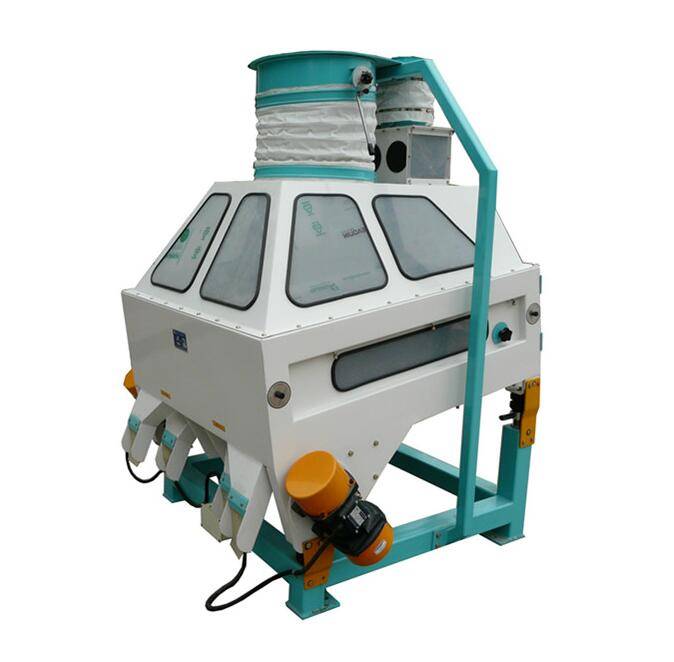
Because the impurities in raw rice are very large, basically between 2.0% and 4%, and some are even higher. In order to meet the increasingly high requirements of customers, many rice processing companies attach great importance to the control of hard foreign matter, and will set up one or more specific gravity stone removal machines (hereinafter referred to as destoner machines) in the rice processing process.
NO1. The important role of specific gravity destoner machine and the setting links
Most rice mills set the stone removal machine before the rice huller. The main reason is that:
1. Before entering the rice huller, the company generally performs preliminary cleaning on the rice, but it is difficult to remove the side stones in the preliminary cleaning process. (Sidestones refer to inorganic impurities such as sand, gravel, slag, etc. that are close to the size of grain grains and are mixed into the grains during harvesting and drying due to various factors). Some enterprises will also clean the rice several times. For example, enterprises that undertake policy reserves generally require that the impurities in the rice must be cleaned to less than 1.0%. It is difficult to meet the requirements by relying solely on initial cleaning. In the flat warehouse entry process, there will be “three cleanings and two blowings” or “three cleanings and three blowings”, such as: raw grain – belt conveyor – cleaning screen – belt conveyor + fan – cleaning screen – belt conveyor + fan – fan – raw grain entering the warehouse; and the rice that directly enters the silo generally adopts a cleaning process with full coverage of the wind net: raw grain – initial cleaning screen – raw grain silo – vibrating screen (or rotary vibrating screen) – raw grain silo – magnetic separation – silo.
2. If the stones in the rice are not separated cleanly, it will accelerate the wear of the consumable parts of key equipment such as the rubber roller of the rice husker, the sand roller of the rice machine, and the rice sieve, and increase the processing cost.
3. The specific gravity stone remover is a stone removal device that can separate rice and impurities according to their density and suspension speed. The stone remover is set before the rice husker instead of after the rice mill. On the one hand, because the specific gravity of rice is lighter than that of rice, it is more conducive to removing the side stones with a specific gravity close to or between that of rice and rice.
NO2. Key points for the operation of the specific gravity stone remover
First, there must be an independent wind network, and the air volume of the stone remover should be adjusted reasonably to ensure that the rice in the stone remover can be blown into a suspended state. The material should be in a loose suspension state on the stone removal plate, but the material layer should not be blown through, and there should be no “blowing through” or “bubbling” phenomena, otherwise it will not only destroy the automatic grading, but also blow some flaky mud blocks from the bottom of the material layer and mix them into the rice.
Second, reasonably adjust the inclination of the screen surface, generally not more than 10°. If the screen surface inclination is too small, the stones are easy to climb up the slope, and more rice will also climb to the stone discharge port. In order to ensure that the stone does not contain too much grain, the reverse airflow speed needs to be increased. In this way, more stone-grain mixtures mainly composed of stones will gather on the screen plate of the stone discharge section, and it is difficult to distinguish between stones and grains, causing full rice to be discharged with stones; on the contrary, if the screen body inclination is too large, it is difficult for the stones to climb up the slope, the stone discharge section is elongated, and some stones will flow to the rice outlet with rice, causing the stone removal efficiency to decrease.
Third, the stones to be removed must contain not only brown rice but also rice. The specific gravity of brown rice is greater than that of rice. Generally, the stone remover will bring out some brown rice at the stone discharge port while discharging stones, but it is not enough to bring out only brown rice. Some stones or other hard foreign objects with a specific gravity close to rice are difficult to be selected;
Fourth, the air duct, glass window and other positions of the stone remover must be strictly sealed, and sealing rubber rings must be added between the docking flanges. The stone remover has soft connections at the feed inlet and air duct. Once damaged, the air volume and air pressure in the machine will be unstable. The soft connection must be replaced in time, otherwise it will directly affect the stone removal effect.
Fifth, the maintenance and replacement of the screen surface.
1. Keep the screen surface flat. When the screen surface is convex and concave, the stones are easy to slip and roll on the screen surface, making it difficult to jump, unable to climb and discharge, and easy to flow to the rice outlet with the material flow, affecting the stone removal effect. At this time, the stone removal screen surface must be replaced.
2. Regularly clean the stones and other foreign objects stuck on the screen surface. When disassembling the screen surface, it is strictly forbidden to press the screen surface with heavy objects. Use compressed air or wire brush to clean the screen surface. It is strictly forbidden to knock it to avoid deformation of the screen.
3. The screen surface must have a regular replacement mechanism to avoid wear. Set up a record board next to the stone remover to record the time of replacing the screen this time and the time to prepare for replacement next time.
Sixth, if the destoner has the phenomenon of stones or materials moving on one side, it means that the screen surface is not horizontal horizontally
or the suspension rod is twisted and the inclination angle is inconsistent or the wind guide plate is deformed or the inclination angle is inconsistent, etc., it is necessary to check the operation of each component on site in detail, and take corresponding measures to correct the deviation according to the problems found in the inspection.
Post time: Jul-22-2025