

Working Principle
The rice polisher mainly rotates the polishing roller to make the rice grains rub and collide with the polishing roller, rice screen and other parts in the polishing chamber. At the same time, the rice in the polishing chamber is sprayed with water evenly in a certain proportion to moisten the rice surface, which is convenient for separating the bran powder on the surface of the rice grains. Under the action of the polishing pressure and the friction temperature of the polishing process, the starch on the rice surface is gelatinized to form a colloid layer, thereby achieving the purpose of improving the brightness of the rice.
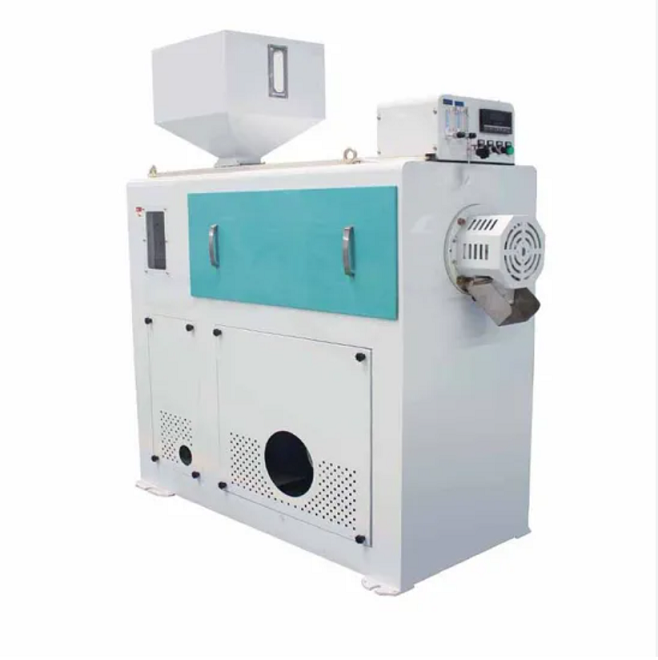
Classification by structural form
Horizontal rice polisher: It has the advantages of simple structure, convenient operation and easy maintenance, and is suitable for rice processing plants of various sizes. When it is working, the rice enters from the feed port, and is polished along the length of the polishing chamber under the action of the polishing roller, and then discharged from the discharge port.
Vertical rice polisher: It occupies a small area, is easy to install, and has a good polishing effect. It is often used in small rice processing plants or family workshops. The rice feed port of the vertical rice polisher is located at the top of the machine, and the discharge port is located at the bottom. The rice grains are polished from top to bottom under the action of gravity and the polishing roller.
Classification by the number of polishing rollers
Single-roller rice polisher: The structure is relatively simple and the price is low. It is suitable for occasions with low processing precision and low output. The single-roller polisher polishes the rice with one polishing roller, and its polishing effect and output are relatively limited.
Double-roller rice polisher: The double-roller rice polisher has the advantages of large output and good polishing effect, and is widely used in large and medium-sized rice processing plants. The double-roller polisher usually uses two polishing rollers to polish the rice at the same time, which can make the rice grains get more sufficient friction and collision, thereby improving the polishing quality.
Function
Improve the appearance quality of rice: remove the bran powder and impurities on the surface of the rice grains, make the rice surface smoother, whiter and brighter, achieve a crystal clear effect, improve the commodity value of rice, and meet consumers’ requirements for the appearance quality of rice.
Prolong the shelf life of rice: During the polishing process, some nutrients and microorganisms on the surface of the rice grains are removed, which reduces the deterioration and corruption of rice caused by microbial reproduction and oxidation reactions during storage, and prolongs the shelf life of rice.
Improve rice processing performance: make rice grains fuller and more uniform, and in the subsequent processing process, such as packaging, transportation, etc., it is not easy to break and scatter, which improves the efficiency and quality of rice processing.
Performance advantages
High wear-resistant parts: the use of highly wear-resistant polishing rollers and screens can meet the polishing process requirements of various types of rice, and has a long service life, reducing the maintenance and replacement costs of equipment.
Accurate water volume control: equipped with advanced water volume control devices, the water flow rate can be accurately adjusted according to needs to ensure uniform wetting of the rice surface, thereby improving the polishing effect.
High degree of automation: imported level meters, solenoid valves, digital display ammeters and other key components, such as FOTMA rice polishing machines, are used to ensure that the control operation of the polishing process is simple, reliable, fast and clear, with a high degree of automation, reducing manual operation errors and improving production efficiency.
Good ventilation system: equipped with air door adjustment devices and imported negative pressure gauges, it can ensure that the entire polishing process is carried out under a quantitative negative pressure state, effectively sucking air, cooling the rice and sucking away loose bran, so that the polishing effect is stable and controllable
Post time: Jul-18-2025