

I. What is Parboiled Rice?
Parboiled rice refers to rice that has been soaked in water, then heated to gelatinize the starch, dried, and finally dehulled and milled. It is a natural, endogenously nutritious, and healthy rice.
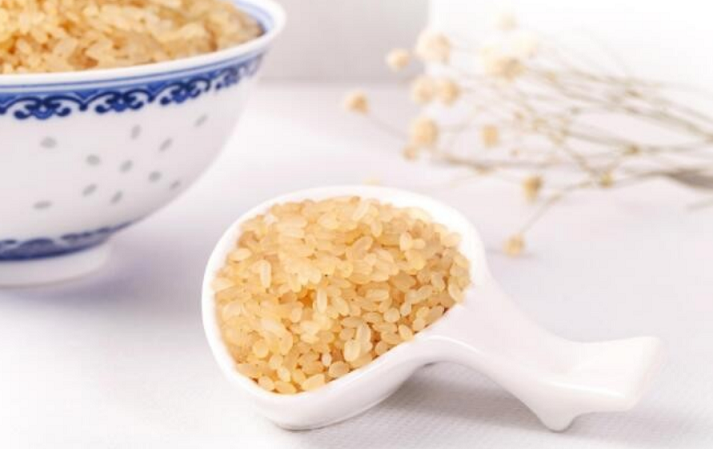
The consumption of parboiled rice in China originated in the Spring and Autumn Period, while records of its processing techniques appear in the Song Dynasty. According to the *History of Chinese Agricultural Science and Technology*, in 1101 AD, Sichuan adopted a rice processing method of “steaming first and then roasting,” marking the beginning of parboiled rice processing technology in China.
Through development, parboiled rice has become very popular in Europe, America, and the Middle East, and is known as a healthy rice, a low-sugar staple food, and the “aristocrat of rice.” In the 1990s, parboiled rice, as a processed rice distinct from brown rice and refined rice, was included in the Codex Alimentarius’s rice standards.
II. The Nutritional and Processing Secrets of Parboiled Rice Parboiled rice, through a modified processing method, allows the nutrients from the bran layer to permeate back into the rice grain, while also stimulating the core nutrients in the germ and restructuring the starch structure of the rice, resulting in more slow-digesting and resistant starch. Compared to regular refined white rice, parboiled rice has higher nutritional value and a lower glycemic index.
(I) A Natural Source of Whole Grain Nutrition Compared to regular refined white rice, parboiled rice contains more nutrients, including dietary fiber, B vitamins, unsaturated fatty acids, protein, and gamma-aminobutyric acid (GABA).
These nutrients come from the natural grain itself—not only the starch in the endosperm, but also a large number of beneficial nutrients found in the germ, aleurone layer, and bran of rice:
Parts: Germ: Vitamin B1, Vitamin E, unsaturated fatty acids, active polysaccharides, protein
Aleurone layer: Protein, unsaturated fatty acids, B vitamins, minerals
Bran: Dietary fiber, B vitamins, minerals
Endosperm: High starch content, low protein content, low trace elements
During the processing of refined white rice, these components are gradually lost as the husk is removed, the bran is peeled off, and the milling process becomes more precise, eventually becoming closer to pure endosperm, containing only a large amount of starch, a small amount of protein, and a small amount of trace elements.
The parboiled rice process, however, allows the rice to be refined and improved in taste while retaining the nutrients in the bran, aleurone layer, and germ, achieving a balance between taste and nutrition.
(II) The Secret to Nutrient Retention & Low GI
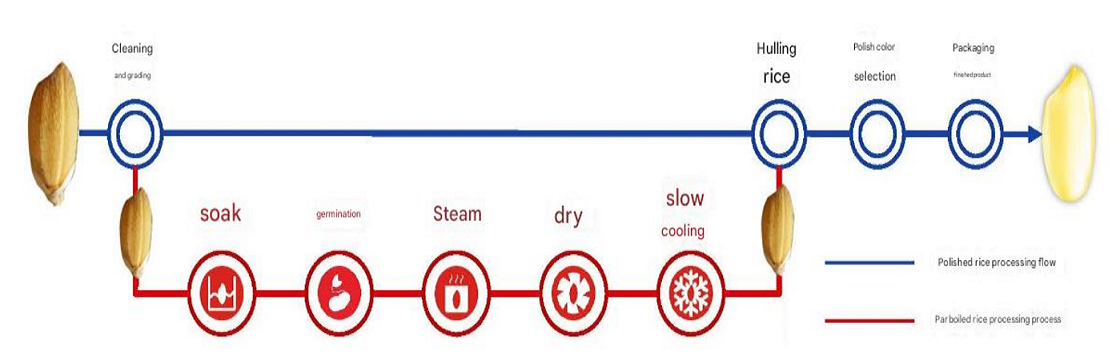
Parboiled rice processing flow diagram
Compared to regular refined white rice, parboiled rice undergoes a series of hydrothermal processes before hulling and milling, including soaking, germination, steaming, drying, and tempering/cooling. The secret to parboiled rice’s unique nutritional value and low glycemic index lies in the following:
Nutrient Reverse Osmosis: During processing, B vitamins, dietary fiber, and other nutrients from the rice bran and aleurone layer seep back into the rice grain under the combined effects of hydrothermal heat and pressure;
Germ Germination: Under specific conditions, the rice germ stimulates the production and retention of substances such as γ-aminobutyric acid (GABA) and unsaturated fatty acids, significantly improving the overall nutrient retention of the rice grain;
Starch Restructuring: The starch structure within the rice grain is optimized and restructured during processing, transforming the original starch into more beneficial, slowly digestible starch and resistant starch, resulting in a significantly lower glycemic index (GI).
III. Advantages of FOTMA MILL Parboiled Rice
(I) Product Advantages
As a third type of rice (classified according to processing technology), distinct from ordinary rice, parboiled rice possesses significantly different characteristics and advantages after undergoing a special self-developed processing technology.
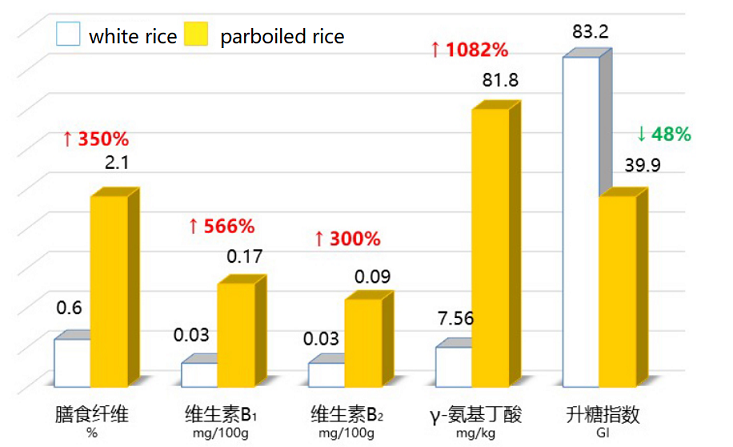
1. Nutritional Advantages
Nutritional Comparison Chart
Parboiled Rice vs. Refined White Rice
During the hydrothermal treatment of parboiled rice, water-soluble nutrients such as vitamins, inorganic salts, and gamma-aminobutyric acid (GABA) diffuse into the endosperm, fully preserving the triple “original” nutrition of the rice bran, germ, and endosperm, making the rice a “high-quality carbohydrate.”
According to calculations, the overall nutrient retention rate of rice is as high as 87% (while polished white rice usually only retains about 5%),[5] [6] among which the nutrient γ-aminobutyric acid (GABA) in the germ reaches 10.8 times that of ordinary rice in parboiled rice, which is comparable to the level of GABA rice (GABA rice, also known as sprouted rice or sprouted brown rice, is called GABA rice because its GABA-γ-aminobutyric acid content is higher than that of ordinary polished white rice, usually 11 times that of white rice). 2. Taste and flavor advantages After processing, the appearance and cooking characteristics of parboiled rice grains are further optimized. Parboiled rice has a natural amber color on the surface, and after cooking, it is yellow like honey. In terms of cooking properties, it has better expansion than rice, with a firm structure and a chewier texture. Such rice grains have a unique luster and aroma after cooking, forming a unique flavor unique to parboiled rice. 3. Low GI Advantage
Besides the remarkable changes in nutrition and taste, parboiled rice has another remarkable advantage: thanks to FOTMA MILL’s patented “processing method for slow-digesting parboiled rice,” the starch structure of rice subtly transforms into a “slow-digestion mode.”
In this “mode,” the content of slow-digesting starch (SDS) and resistant starch (RS) in parboiled rice increases, thus reducing starch digestibility and significantly decreasing postprandial blood glucose fluctuations. Simultaneously, the structural change makes parboiled rice more satiating, giving it the reputation of being a low-glycemic index food.
(II) Broad Application Potential
1. Suitable for a Wide Range of People
Furthermore, after processing, parboiled rice protein becomes more easily absorbed and digested by the human body. In comparative experiments, researchers found that the human digestibility and absorption rate of parboiled rice protein is about 4.5% higher than that of ordinary white rice, making it particularly suitable for infants, the elderly, or people with illnesses.
Easily absorbed, highly nutritious, and low GI—these are key factors that consumers focus on in today’s health-conscious society. The advantages of parboiled rice are beneficial to people of almost every age group. Its low GI and satiating properties are even appealing to health-conscious individuals, highlighting its broad appeal and promising future market potential.
2. Diverse Applications
FOTMA MILL parboiled rice’s unique processing technology stabilizes its starch, enhancing its flavor and texture in various processed forms (such as powdering, pre-made fried rice, and fresh rice). It is one of the best raw materials for processed rice products, sugar-controlled foods, and pre-made rice products.
Furthermore, FOTMA MILL parboiled rice’s superior levels of the core germ nutrient gamma-aminobutyric acid (GABA) and diverse grain nutrients make it a rising star in the children’s rice category, following germ rice.
Post time: Mar-04-2026