

A suitable operating temperature can reduce wear and tear on the 60-ton rice milling equipment, and its lifespan is often a concern for users.
People want their 60-ton rice milling equipment to generate greater value within its effective service life. This requires operators to perform correct operation and regular maintenance, paying particular attention to controlling the operating temperature of the entire grain processing equipment to avoid severe wear.
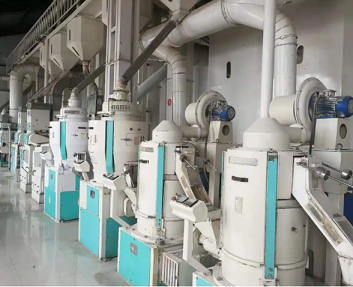
The 60-ton rice milling equipment uses a unique production method, employing uniform-speed automated processing and low-temperature operation. Under normal circumstances, wear on the 60-ton rice milling equipment is minimal.
However, high-temperature environments have a significant impact on the 60-ton rice milling equipment. Lowering the operating temperature by seven levels can reduce wear and extend the service life of the 60-ton rice milling equipment.
The 60-ton rice milling equipment is widely used in the food processing industry. After using the rice milling equipment, we need to conduct a careful inspection to check whether the protective devices are functioning properly and whether the wiring is intact.
What are the negative consequences if a 60-ton-per-day rice milling machine is not installed stably?
1. If the ground where the rice milling machine is installed has a high slope, the material in the small rice processing equipment is very likely to deviate, affecting the processing capacity of the entire rice milling machine.
2. Using the rice milling machine on uneven ground will significantly increase the vibration frequency of the equipment, making it more prone to malfunctions.
3. A flat ground also facilitates the movement of the rice milling equipment, making the entire set of equipment more convenient to use in the future.
What conditions must be met for the economic specifications of a 60-ton-per-day rice milling machine?
1. Health Applicability. For the mechanical structure of food processing machinery such as a 60-ton-per-day rice milling machine, critical control points for health hazards should be identified, and measures should be taken to ensure the hygiene requirements of the mechanical structure.
2. Scale Applicability. Currently, food processing plants use equipment of three sizes: large, medium, and small. According to industrial policies and development requirements, the focus should be on developing large and medium-sized production scales, while small-scale production enterprises should follow market economy principles.
3. Applicability of a 60-ton-per-day rice processing plant. In industrial food processing, most products are not produced on a single machine but rather assembled on a production line. Therefore, the applicability of a 60-ton-per-day rice processing plant is crucial for ensuring continuous production, balanced production, processing performance, and product quality.
The principles of a 60-ton-per-day rice processing plant are to achieve a reasonable economic scale, meet technological requirements, and ensure a proper match between different pieces of equipment. To guarantee the normal operation of the production line, energy conservation and environmental protection, and convenient maintenance, the characteristics, rationality, and reliability of the production line are ensured.
Post time: Mar-10-2026