

Rice huller vs. rice mill: A complete analysis of their functions and principles
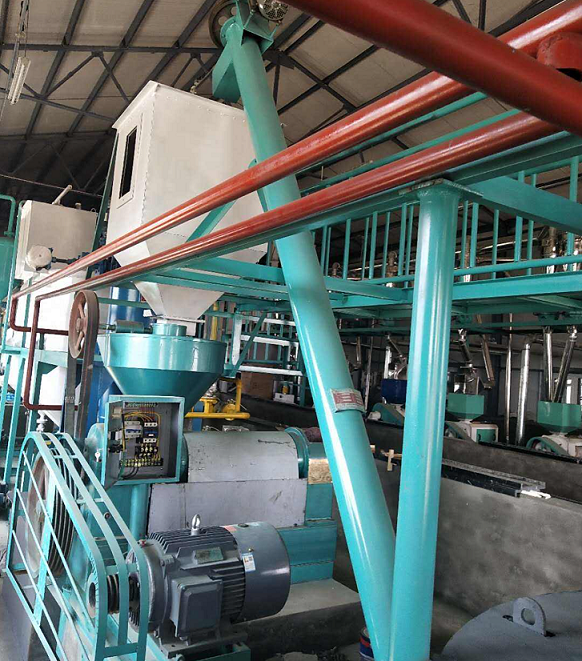
Rice hullers and rice mills undertake the core tasks of hulling and fine grinding in the rice processing industry chain. They differ fundamentally in their functional positioning, technical principles, and equipment specifications.
Functionally, the rice huller, as the first step in the process, removes the rice husks through differential friction between rubber rollers. This results in a hulling rate exceeding 85% and a brown rice breakage rate of less than 2%, producing semi-finished brown rice containing the germ layer within the bran layer. The rice mill is responsible for the fine processing, using sand/iron rollers to remove the bran layer. Modern models use a combination of technologies to increase the germ retention rate to 80%, and are equipped with a temperature control system to maintain a whitening chamber temperature of ≤40°C to prevent the loss of vitamin B1.
Technically, the rice huller relies on friction generated by a 20% speed difference to remove the rice husks. A wind-powered sorting system achieves a separation efficiency exceeding 95%. Rice milling technologies are differentiated into three types: emery roller models use high-speed cutting to achieve rapid hulling; iron roller models use low-speed rolling to control the broken rice rate to ≤3%; and flexible rice mills use layered grinding technology to reduce the broken rice rate of long-grain indica rice to 7.9%, reducing energy consumption by 37.1%.
A comparison of equipment parameters shows that the core speed of a rice huller is 960-1200 r/min at a differential speed, with no mandatory temperature control required. It produces brown rice with a bran layer and a typical energy consumption of 0.55 kW·h/kg. A rice milling machine operates at a constant speed of 800-1200 r/min, requires a whitening chamber temperature of ≤40°C, and ultimately produces white rice with a bran layer thickness of ≤0.1mm. Energy consumption varies depending on the machine model, ranging from 7.3-14.9 kW·h/t.
In specific applications, rice huller selection should be tailored to the rice variety and hulling efficiency requirements. For example, Nongxiang 42 rice requires equipment with a hulling rate of at least 98%. Rice mill selection should be considered based on product positioning: Traditional models are suitable for japonica rice in northern China, while flexible rice mills are preferred for indica rice in southern China. High-end markets require models with intelligent temperature control to ensure vitamin B1 retention rates exceeding 90%.
Technological evolution is showing two major trends: integrated hulling and milling, and digital twin control. Combined hulling and milling machines achieve full process automation through equipment integration, achieving an overall efficiency of 92%. Flexible rice mills, equipped with AI algorithms, control rice temperature rise to within 5.2°C, a 45% reduction compared to traditional models. Recommended models are differentiated by production capacity: small workshops should choose combined hulling and milling machines, while high-end production lines require intelligent temperature control equipment. Layered grinding functionality is essential for indica rice processing. Accurately matching equipment parameters with product requirements is key to optimizing processing flows and controlling costs.
Post time: Aug-06-2025