

A small rice milling machine is a machine used to process paddy rice. It can husk and mill the paddy rice, making it cleaner, more appealing, easier to store, and easier to eat. Small rice milling machines are generally suitable for small farmers, rural households, and small agricultural product processing enterprises. They are characterized by their small size, light weight, simple operation, and high efficiency. Below are some common types of small rice milling machines:
1. Manual Small Rice Milling Machine: A manual small rice milling machine is a simple machine, usually consisting of a hand crank and a milling mechanism. Its advantages are low price and ease of operation, making it suitable for small-scale family or farmer use. However, its production efficiency is lower, and it requires manual operation, making it unsuitable for large-scale production.
2. Electric Small Rice Milling Machine: An electric small rice milling machine is a machine driven by an electric motor, which can automatically complete the husk and milling of paddy rice. Its advantages are high production efficiency, simple operation, and easy maintenance, making it suitable for small agricultural product processing enterprises and rural households. However, it is more expensive, requires power, and is not suitable for areas without electricity.
3. Diesel-powered Mini Rice Milling Machine: This machine is powered by a diesel engine and automatically hulls and mills paddy rice. Its advantages include wide applicability, high production efficiency, simple operation, and easy maintenance, making it suitable for rural households and small agricultural product processing enterprises. However, it is more expensive, requires diesel fuel, and is not suitable for areas without diesel supply.
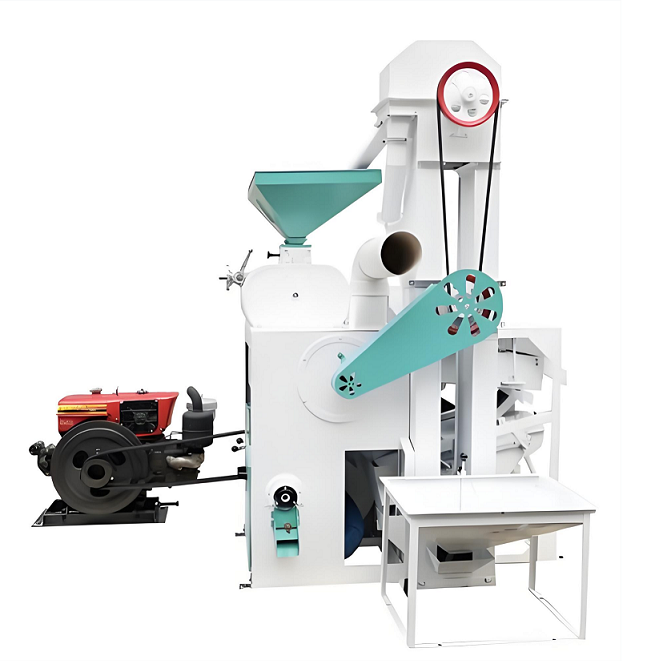
4. Solar-Powered Mini Rice Milling Machine: This machine is powered by solar panels and automatically hulls and mills paddy rice. Its advantages include environmental friendliness, energy saving, and wide applicability, making it suitable for areas without electricity or diesel supply. However, it is more expensive and requires areas with abundant sunshine.
In conclusion, there are many types of mini rice milling machines. Choosing the right machine requires considering factors such as production scale, economic strength, and energy supply.
PS.
Troubleshooting a Slow-Speed Rice Mill with a Diesel Engine
I. Power System Inspection
When the rice mill speed decreases, first check if the diesel engine’s power output is normal:
Fuel System: Check if the diesel filter is clogged. Inferior diesel fuel easily produces gum deposits.
Air Supply: The air filter needs to be cleaned every 200 hours of operation. Clogged filters will lead to incomplete combustion.
Drive Belt: Press the middle of the belt with your thumb. A 5-8mm indentation is normal. A loose belt will slip.
Engine Oil Condition: Dark, viscous engine oil increases internal engine resistance.
II. Rice Mill Mechanical Maintenance
Maintenance of the equipment itself is equally crucial:
Bearing Lubrication: The main shaft bearing needs to be lubricated with high-temperature grease every 3 months.
Screen Cleaning: Residual rice bran can cause screen blockage exceeding 60%, affecting output efficiency.
Hammer Wear: When wear exceeds 1/3 of the original thickness, crushing efficiency decreases significantly.
Dynamic Balance Calibration: Rotor eccentricity can cause abnormal vibration, increasing energy consumption.
III. Optimization of Operating Techniques
Proper usage can extend equipment life:
Preheating Preparation: The diesel engine should idle for 3-5 minutes before loading to avoid overloading when cold.
Feeding Control: Maintain uniform feeding; sudden excessive feeding can cause a sudden drop in speed of 15%.
Environmental Adaptation: For every 1000 meters increase in altitude, diesel engine power decreases by approximately 8%.
Regular Maintenance: It is recommended to conduct a comprehensive inspection of the tightness of transmission components every quarter.
Post time: Feb-25-2026