

Currently, research on oil press machinery both domestically and internationally has focused on multiple directions, with most utilizing single-screw oil presses, twin-screw oil presses, drum-type three-stage screw oil presses, and ordinary bar-type three-stage screw oil presses. Research can also concentrate on aspects such as oil penetration, screw structure, pressing chamber, and feeding structure. This article analyzes the working principle and related structural fundamentals of oil presses. It compares the advantages and disadvantages of some screw oil presses and proposes suggestions regarding the insufficient performance of key components affecting oil pressing efficiency.
Keywords: Screw oil press; oil pressing technology; structural design
Edible oil is an essential commodity. With the decline in vegetable oil production and insufficient raw material supply in recent years, the outdated nature of oil pressing machinery has become a significant factor restricting the production and quality of edible oil. Currently, pressing and solvent extraction are the main oil extraction processes. Since the production of the first continuous screw oil press in the United States in 1900, oil extraction methods have shifted from traditional intermittent to continuous pressing. To improve production efficiency and increase output, the vigorous development of oil presses is crucial.
Screw oil presses extract oilseeds by applying shear and extrusion forces within the pressing chamber, causing the oil to rotate and be extracted. Due to its high oil yield, energy efficiency, and ability to maintain high naturalness, the screw oil press has become a widely adopted oil extraction method.
1. Current Status of Screw Oil Pressing Machinery Research
1.1 International Research Status
Internationally, research on oil presses has a history of over a century, with tests and analyses conducted on various key factors affecting the oil yield of screw oil presses. Among these studies, Nigerian scholar T-O-Omobuwajo investigated the relationship between pressure and oil flow rate and developed a theoretical model. Researchers at the American company Vicent have designed a parallel twin-screw press with two intermeshing screws rotating in opposite directions. This invention has shown significant effects in reducing slippage and enhancing the forward displacement of the material. By fixing toothed scrapers to the press cage and inserting them into the spiral spacers, the effects of stirring and preventing blockage are achieved.
In 1936, the American Andreas Hartner Hans developed the twin-screw oil press. This twin-screw press, with its two equal-length screws, improved the pressing efficiency at the oil inlet. During pressing, the oilseeds are deformed and broken under strong compression and shearing forces within the pressing chamber. To increase the compression ratio and allow the oilseeds to gradually increase in pressing pressure to the pressing point, Andreas Hartner Hans designed the screw pitch of the two screws to gradually decrease, thereby achieving better pressing efficiency and increasing oil yield.
Japan’s first twin-screw oil press was developed in 1990. The French company Speichim designed a pressing production unit with a processing speed of up to 12 tons per minute. The British company Simo-Rosedowns used spiral nitriding technology and tungsten-chromium-cobalt hard alloy to treat its spiral oil press, enabling it to withstand high pressure.
Water cooling is applied to the screw oil press to prevent the formation of harmful substances due to high-temperature burning within the pressing chamber, effectively improving oil quality. The double-screw feeding device uses forced feeding, achieving a pressing capacity of 40-65 t/d.
1.2 Current Status of Domestic Research
Research on screw oil presses in my country has a history of at least 70 years. Based on double-bottom rapeseed peeling, Li Shilong et al. proposed a key technology in the cold pressing process: a two-stage, multi-stage cold pressing structure model. Building upon the work of H,J. Lazehong et al., they achieved multiple compression and relaxation processes within the compression chamber, increasing the pressure of the main pressing section and effectively improving oil yield. This made a significant contribution to my country’s oil press technology.
Meanwhile, the Beijing Institute of Food Science and Technology, in collaboration with the Tianjin Institute of Physical and Chemical Engineering of the Nuclear Industry, developed the YZYXD type screw oil press. This machine utilizes a combination of water cooling technology and temperature sensors to achieve real-time monitoring of temperature changes during the pressing process, while maintaining an oil extraction temperature below 70℃. Wuhan Institute of Technology, in collaboration with local enterprises, developed the LYZX series screw oil press, achieving a residual oil rate of no more than 8% after the second pressing.
2. Development Issues of Major Components of the Screw Oil Press
2.1 Single-Screw Main Pressing Section
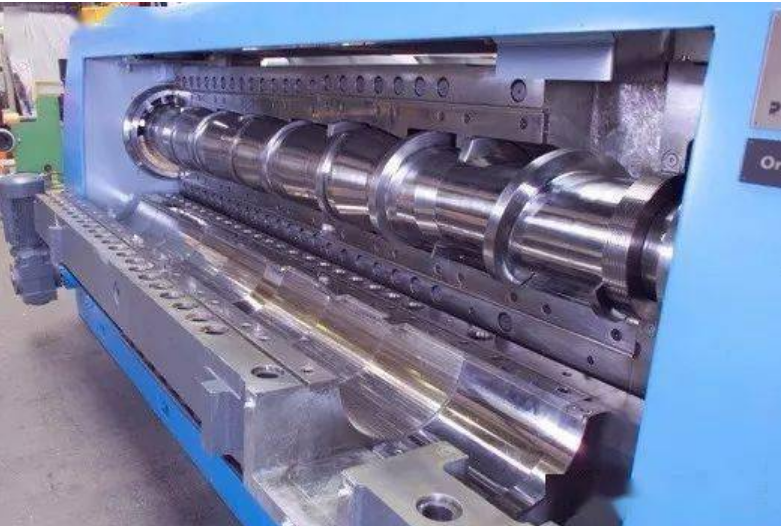
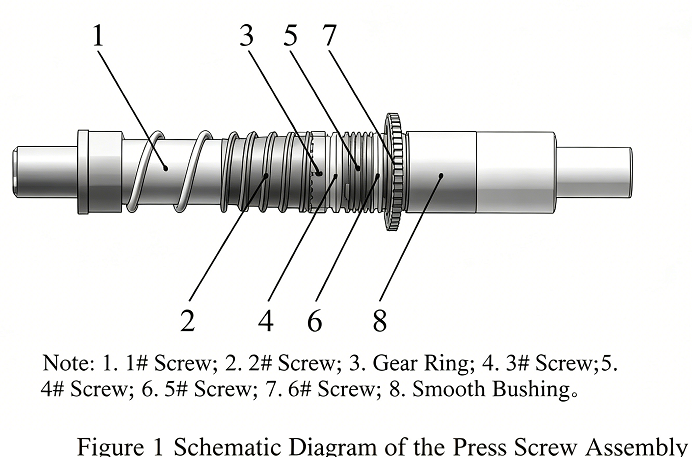
The oil press uses a screw to propel the material, generating compression and friction. A modular structure can be adopted for easy replacement. As shown in Figure 1, the pressing cage encloses the screw section, and a coupling connects the feed end to the reducer, while the main shaft at the cake outlet is connected to the cooling components. After passing through the conical-bottom screw, the pressure is released, creating a new oil passage inside. Current market usage shows its widespread use due to its simple design and low price. However, because the material conveying method mainly relies on friction, its feeding capability is limited, and inorganic fillers, glass fiber, and similar materials are difficult to add. When the pressure at the die head is high, backflow increases, reducing productivity. Single-screw extruders have limited surface renewal effect on organic materials in the exhaust zone, making them unsuitable for processing techniques such as polymer coloring.
2.2 Twin-Screw Oil Press Mechanism
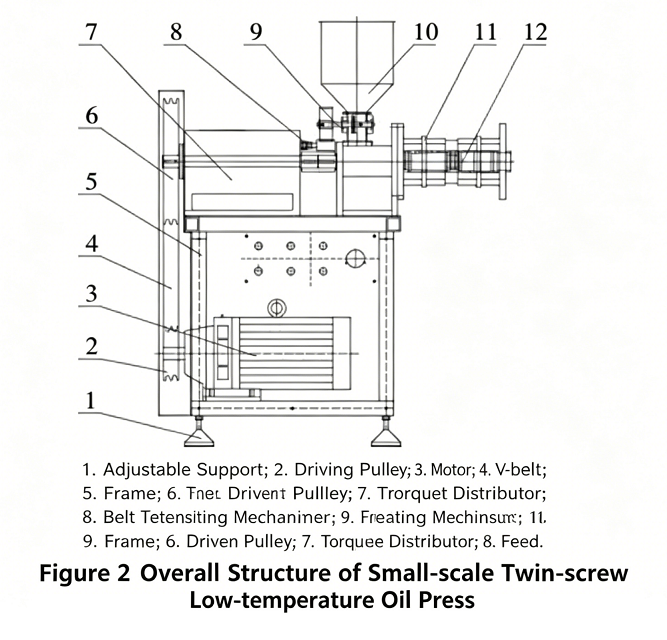
Due to increasing demands for oil quality, the invention of the twin-screw oil press gradually met societal requirements. A small twin-screw low-temperature oil press consists of a main drive system, torque distribution mechanism, feeding mechanism, pressing mechanism, and frame, as shown in Figure 2. Its pressing mechanism comprises two parallel screws rotating in opposite directions. The shearing ring is a curved triangular ring, and by changing the angle between the keyway and the apex of the triangle, it is staggered to form a blade-like spiral, which improves the pressing effect of the oilseeds.
The length-to-diameter ratio of the screws in ordinary medium and large-sized twin-screw low-temperature oil presses is generally 12-25, consisting of 6-8 screw sections. Compared to traditional twin-screw oil presses, small twin-screw low-temperature oil presses add a shearing ring, reduce the number of screws to only 4 sections, shorten the screw length, and simplify the screw structure. Shearing rings need to be used in groups of 3-5. Theoretically, the misalignment angle between each shearing ring is inversely proportional to the conveying capacity, combining shearing and pressurizing effects. During oilseed pressing, the shearing rings primarily function to break up oilseed particles, increase pressure, and open oil passages.
During oil pressing, it’s common to see high oil yield in the initial pressing stage but low yield in the later stages. This is mainly due to unsuitable moisture content in the raw materials. Therefore, to achieve higher oil yield standards, plasticity can be gradually increased. Optimal oil yield occurs when the moisture content reaches a certain standard value. For oilseed crops, a critical moisture range exists when good pressing results are achieved, and this range is affected by temperature. Higher temperatures increase plasticity, while lower temperatures decrease it.
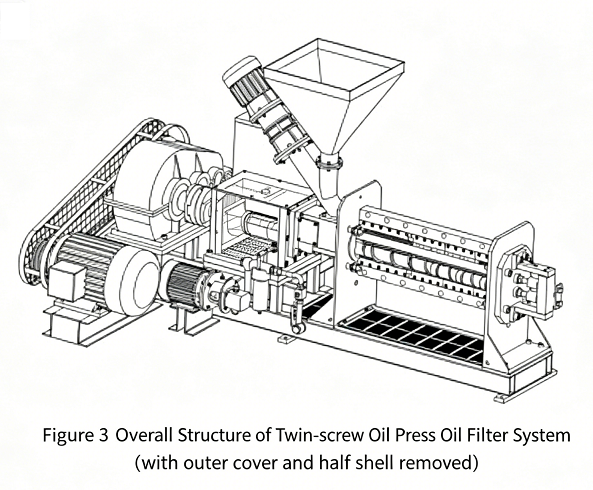
Adding a filtration device is also necessary. During oil pressing, material residue splashes into the oil tank, mixing impurities into the oil. Therefore, post-press filtration needs to be considered, either by adding a filter screen to screen the oil or by adding filter cloth to the filter screen. This lays the foundation for subsequent work, as shown in Figure 3.
3. Three-Stage Screw Oil Press
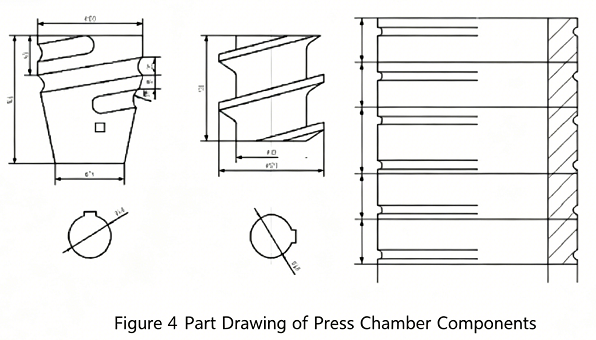
The pressing chamber and pressing rods are crucial to the oil yield and stability of the oilseed pressing process. They are also the core components of the three-stage screw oil press. Due to the large number of pressing rings in the bar-type pressing chamber, processing is difficult, assembly is troublesome, and costs are high, resulting in serious problems and a low oil yield. Therefore, the cylinder-type oil press, based on the ordinary oil press, uses multiple pressing rings or bars, with the cylinder and pressing chamber integrated. This makes the outer surface of the cylinder and the pressing chamber form an arc surface, and through this tight connection, the heat transfer speed of the heating components is fast and the heat distribution is uniform. In comparison, the cylinder-type three-stage screw oil press is more economical than the ordinary bar-type three-stage screw oil press, with a higher oil yield and a lower residual oil content in the dried cake, as shown in Figure 4.
4. Conclusion
Both single-screw and twin-screw oil presses have various problems. Controlling the moisture content and temperature of the oilseeds is paramount and requires improvement from the perspectives of mechanical design and material usage adjustments.
With societal development, the machinery manufacturing industry has gradually become a popular sector due to people’s desire for more and better edible oil. To solve the various existing problems, active improvement and enhanced risk awareness are necessary. In future work, the aforementioned issues will also be addressed through optimization and improvement.
Post time: Apr-28-2026