

On April 2nd, reporters visited the production workshop of New Hope Food Co., Ltd. in Hubei Province. At FOTMA MILL, the automated and intelligent grain processing production line was operating efficiently, transforming paddy rice into whole grains of rice through a series of processes.
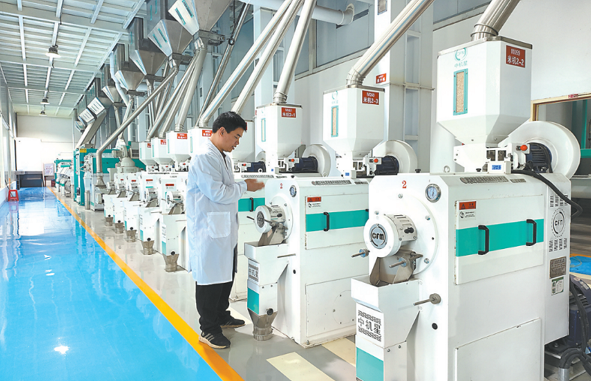
Photo: Staff checking the operation of the production line equipment
Upon entering the factory area, the 32 towering vertical grain silos immediately catch the eye. Each silo is 17 meters high and has a capacity of up to 145 tons. Next to the silos, with a “beep,” an automatic unloader unloads 40 tons of paddy rice into a 7-meter-deep silo. Immediately afterwards, a “clattering” sound rang out as a hoist automatically transported the paddy rice to a silo on the third floor. A large automatic impurity removal machine performs preliminary purification of the paddy rice, processing 50 tons per hour.
Entering the assembly line workshop, the sound of the machines is even clearer. Paddy rice is hoisted from the silo to a rice huller for hulling, and then a gravity screen precisely separates the paddy rice from the brown rice. Twelve rice milling machines operate simultaneously on-site, employing a “light pressure, multi-milling” process. The rice undergoes four milling stages, followed by water polishing and grading, and finally, it is screened by three color sorters before entering the cooling warehouse. Each step operates in a closed system, eliminating the traditional scene of manual labor and dust in rice mills.
In a corner of the workshop, the reporter saw the “smart brain” of this production line—a PLC intelligent digital control system. The system screen displays real-time data on processing volume, output, and energy consumption, and the equipment starts and stops automatically. In case of material blockage or malfunction, the system intelligently identifies and quickly handles the issue, eliminating the need for manual inspections.
Inside the finished product packaging workshop, fully automated packaging machines precisely measure and seal the rice, while high-speed palletizers automatically transport and stack 500 bags of finished product per hour. Forklifts then transport the rice stacks to the warehouse or load them directly onto trucks, eliminating the need for manual handling throughout the entire process.
“Our FOTMA color sorter is currently the most advanced in China. It can precisely remove impurities, even tiny particles of different colors, ensuring the purity of the finished rice,” Pan Liang, Chairman of New Hope Food Co., Ltd., told reporters. From paddy rice processing to finished rice warehouse, the process involves 16 steps, with the production line producing 12.5 tons of rice per hour. The application of automated equipment has increased production efficiency by over 50% and improved the rice yield by 3-5 percentage points.
As the first fully automated rice processing enterprise in the city, New Hope Rice Industry has invested over 90 million yuan to build two production workshops and two intelligent grain warehouses, including vertical silos and temperature-controlled warehouses, with a total storage capacity of 10,000 tons. The company has also introduced two advanced domestic and international refined rice and sprouted brown rice processing lines, with a daily production capacity of 300 tons, which officially went into operation last February. By strictly selecting high-quality paddy rice and relying on an intelligent rice blending system, nearly 30 products are blended to meet diverse consumer demands.
While improving quality and efficiency, the company is actively exploring a green and circular development path. Pan Liang said, “Every part of the paddy rice is valuable.” Dust collected during production can be recycled and used to make mosquito coils and fertilizers; rice bran can be used for oil extraction, animal feed, and amino acid extraction; rice husks can be further processed into carbon black through carbonization, used as a tire blackening agent; and thermal energy can also be recovered and utilized. The company is planning to add 20,000 tons of storage capacity and, leveraging local resource advantages, plans to add a carbon black production project to further extend the industrial chain. By fully utilizing every grain, the company aims to build a complete closed-loop industrial chain, promoting the transformation of grain processing from single-product production to high-value, resource-based, and green development, and empowering food security with technology.
Post time: Jun-09-2026