

Whether used to add flavor to breakfast toast or to rescue dry skin during autumn and winter, coconut oil has become a versatile staple for many. Yet, 90% of people are mistaken—coconut oil is not made from coconut shells! Shells consist entirely of woody fibers and yield not a drop of oil; the true source is the tender white coconut meat, which boasts an oil content of 60–70%. Drawing on our years of experience in developing edible oil machinery, we break down the four-step coconut oil production process to show you exactly how this high-quality natural oil is made.
Step 1: Pre-processing coconut meat into high-quality dried coconut. After harvesting, fresh coconuts are de-shelled—either mechanically or manually—to extract the meat. Since the fresh meat has a high moisture content, it must first be washed to remove shell fragments and impurities. The washed meat is sliced into uniform, thin pieces to increase the surface area for air-drying or oven-drying, thereby accelerating moisture evaporation. Natural air-drying takes 3–5 days, requiring periodic turning to ensure even drying. Alternatively, professional drying equipment can be used to reduce the moisture content to below 10%, resulting in hard, dry coconut pieces ready for the subsequent oil extraction stage.
Step 2: Pre-treating dried coconut to boost oil yield. The dried coconut must be crushed into fine particles or powder; this breaks down the fibrous structure and increases the contact area with the pressing equipment—a crucial step for maximizing oil yield. If using a hot-pressing process, the crushed coconut powder is briefly heated to 60–80°C to lower the oil’s viscosity and remove residual moisture. In contrast, the cold-pressing process skips pre-heating, proceeding directly to the pressing stage to preserve more nutrients.
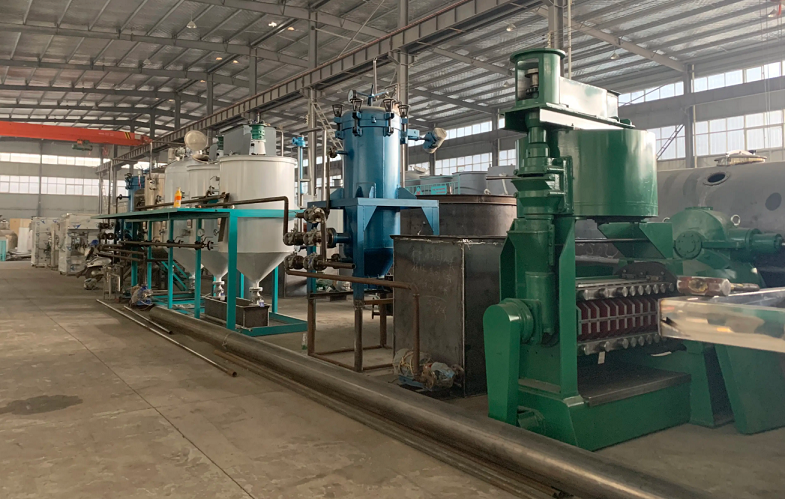
Step 3: Physical pressing to separate the oil from the raw material. This is the core stage of coconut oil production, typically achieved through physical mechanical pressing. The prepared dried coconut material is fed into the pressing equipment, where immense physical pressure separates the coconut oil from the coconut meal. During the pressing process, the control of pressure and rotational speed directly impacts the oil yield and quality; insufficient pressure results in incomplete extraction, while excessive pressure can cause the raw material to carbonize.
Step 4: Refining and purification to meet edible standards. Freshly pressed crude coconut oil contains impurities, moisture, and protein sediments; it must first undergo preliminary filtration through a mesh screen to remove large particles. It is then allowed to settle for 24–48 hours so that fine impurities can settle naturally. For food-grade coconut oil, additional refining steps—such as degumming, deacidification, bleaching, and deodorization—are required to further remove moisture and trace impurities, thereby enhancing purity and shelf life. Following this process, pure, high-quality coconut oil is ready for production.
Transforming fresh coconut meat into clear, bright coconut oil relies on precision processing and specialized equipment at every stage. Selecting the right production equipment and strictly controlling each step are essential to preserving the coconut meat’s inherent nutrients and aroma, ensuring the production of premium coconut oil. Professional coconut oil production equipment offers not only high efficiency and stability but also maximizes the retention of nutrients—such as vitamins, minerals, and unsaturated fatty acids—during the pressing process.
Post time: Oct-12-2026