

Today, I’m going to give you a detailed breakdown of a complete whole-process production line for rice milling equipment that handles 100 tons of paddy per day. From the moment raw grain arrives at the factory to the final packaging of finished rice, I’ll walk you through every step clearly and thoroughly. These are all practical, on-the-ground operational processes from actual production—no unnecessary fluff.
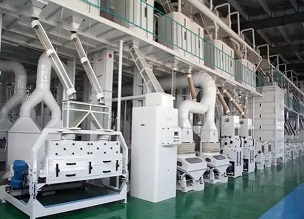
The core of our 100-ton-per-day rice milling equipment adopts the industry-proven and efficient two sand rollers + two iron rollers + three polishers + three color sorters process. This not only ensures the processing precision of the rice but also minimizes the broken rice rate, balancing both output and quality—that’s one of the key advantages of our production line.
First up is the raw grain receiving stage.
The delivered raw grain (paddy) first enters a scraper conveyor, which slowly transports it to the first elevator to avoid crushing or damaging the grain during transportation. The elevator then moves the raw grain to the pre-cleaning system: first, it goes through a drum pre-cleaner to initially screen out large impurities in the paddy, such as stones, weeds, and rice straws. Immediately after that, it enters a vibrating cleaner to further remove small impurities like soil, broken chaff, and shriveled grains, ensuring the cleanliness of the raw grain. The cleaned paddy is then sent to the elevator again and transported to the raw grain silo for temporary storage, facilitating continuous processing later and preventing production delays due to insufficient raw grain supply.
When formal processing starts, the paddy in the raw grain silo is transported to the first elevator of the processing line, which lifts it again to the cleaning equipment—the high-efficiency vibrating cleaner. This step is a secondary cleaning, mainly to separate any small amount of impurities that may have mixed in during storage. It ensures the paddy entering the next process is free of any impurities, laying a solid foundation for subsequent processing.
After cleaning, the paddy enters the stone remover
—a crucial piece of equipment. Its main function is to extract stones (stones similar in size to paddy grains) and heavy materials (such as small pebbles and metal debris). Don’t underestimate this step: if stones enter the subsequent processes, they will not only affect the rice quality but also damage the equipment’s rollers and screens, causing unnecessary losses. After stone removal, the paddy moves to the hulling stage. The huller separates the rice husk from the brown rice completely through extrusion and friction. The separated mixture then enters a grain-brown rice separator for classification: the rice husk and part of the mixture are sent back to the huller for re-separation and screening, while the unhulled paddy is returned to the huller for secondary hulling until it is completely hulled. Only the fully hulled brown rice without any husk is transported to the brown rice silo for temporary storage, waiting for the next rice milling process.
Next is the core rice milling stage.
Our equipment uses a combined process of two sand rollers and two iron rollers. The sand rollers are mainly responsible for initially grinding off the bran on the surface of the brown rice and removing the brown rice’s outer layer. The iron rollers then perform further fine milling to make the surface of the brown rice smooth, gradually approaching the state of finished rice. After milling, the rice enters a classifier, which separates large broken rice, small broken rice, and whole-grain rice. The whole grains move to the next process, while the broken rice is collected separately for secondary processing and utilization later—no waste of raw materials.
After milling, the rice enters the rice cooling system
—a step many people overlook, but it’s actually very important. Each rice cooling silo in our system is equipped with an independent rice cooling air network. The air network delivers air evenly, quickly and effectively lowering the temperature of the rice just after milling. As we all know, freshly milled rice is very hot; if it directly enters the next process, it is prone to cracking, increased broken rice, and reduced storage time. In addition, the top of the rice cooling silo is equipped with a discharge trolley, which distributes the rice evenly during unloading to avoid crushing and damage caused by concentrated falling of rice, reducing the broken rice rate. The bottom uses a belt conveyor for stable transportation, further reducing broken rice loss. These detailed designs are all to maximize the integrity of the finished rice.
After cooling, the rice enters the fine processing stage.
This stage uses three polishers, three color sorters, and one broken rice classifier to check the quality of the finished rice at every level. First, it enters the polisher: polishing removes any remaining small amount of bran on the rice surface, improves the texture and luster of the rice, and makes the rice look plumper and more marketable. Immediately after that, it enters the first color sorter, which uses photoelectric sensing to effectively separate and remove discolored grains (such as yellow grains, diseased grains, and impurity grains) from the rice, ensuring uniform color of the rice. Then it enters the second and third polishers to further enhance the luster and smoothness of the rice, taking the quality of the finished rice to the next level. After polishing, the rice enters another broken rice classifier to screen out any broken rice generated during processing again, ensuring that the rice entering the finished product silo has basically no broken grains and meets quality standards.
After classification, the rice enters the final color sorter for final quality inspection and screening, completely removing any remaining small amount of discolored grains and broken rice to ensure the purity and quality of the final finished product. The qualified finished rice is transported to the finished product silo for storage, waiting for packaging.
Finally, the packaging stage.
We are equipped with a vacuum packaging machine and an automatic packaging scale. Vacuum packaging can effectively extend the shelf life of the rice, preventing it from getting damp, moldy, or infested with insects. The automatic packaging scale can accurately control the weight of each bag of rice, ensuring uniform packaging specifications and improving packaging efficiency. After packaging, the finished rice is transported to the finished product area by a conveyor, stacked neatly, and waiting for delivery and sale.
That’s the complete whole production process of this 100-ton-per-day rice milling equipment. From raw grain cleaning to finished product packaging, every link is carefully designed to ensure both production efficiency and rice quality. It is suitable for large-scale paddy processing.
Post time: May-05-2026