

In the process of modern agricultural industrialization, rice processing has shifted comprehensively from traditional small-scale workshop models to large-scale, intelligent production. A rice milling line with a daily capacity of 100 tons represents a medium-to-large processing scale; it differs both from small-scale processing for personal use and from ultra-large facilities with daily outputs of over a thousand tons. Configuring a line of this magnitude requires balancing investment costs, rice yield, broken rice rates, and energy consumption to ensure stable economic returns during continuous, high-load operation.
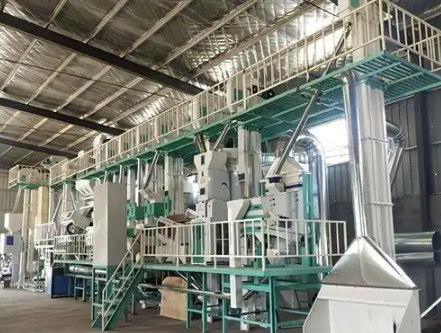
To build an efficient 100-ton/day rice milling line, the primary task is the scientific planning of the raw grain intake and cleaning systems. Given that a daily output of 100 tons implies processing approximately 12.5 to 15 tons of paddy per hour (based on two-shift or extended single-shift operations), the intake stage must feature high-efficiency elevators and pre-cleaning screens to facilitate rapid unloading and the removal of large impurities such as straw and stones. Subsequently, the paddy must pass through a combined cleaning and destoning unit; utilizing specific gravity differences to precisely remove stones and clods of a similar size to the grain is a crucial first step in protecting the rubber rollers of downstream huskers and minimizing equipment wear. Inadequate cleaning can damage expensive core components and introduce impurities into the finished rice, directly harming brand reputation.
The core husking and whitening stages constitute the “heart” of the production line. For a 100-ton capacity, it is generally recommended to configure two or three large rubber-roller huskers to operate in parallel, with a standby unit reserved to prevent a single-machine failure from halting the entire line. After husking, the brown rice undergoes multi-stage separation to ensure that the rates of unhusked paddy in the brown rice stream and brown rice in the paddy return stream remain within national standards—a fundamental requirement for maximizing rice yield. For the whitening stage, a “multi-stage, light-milling” process is recommended, utilizing a series of three to four emery-roller or iron-roller whitening machines. Compared to traditional methods involving fewer stages of heavy milling, this approach effectively lowers the surface temperature of the rice kernels, reduces the generation of broken rice, and results in a smoother, more polished kernel surface. This processing method is particularly advantageous for high-quality *japonica* or premium *indica* rice, as it maximizes the retention of the grain’s nutritional layers and structural integrity.
Polishing and color sorting are the finishing touches that significantly enhance the commercial value of the rice. After the initial whitening process, the rice enters a twin- or multi-chamber polisher; water-mist polishing imparts a crystalline luster to the grain surface and extends shelf life. Subsequently, a high-precision color sorter is essential. Modern color sorters should feature full-color recognition and foreign object rejection capabilities, enabling them to remove not only discolored grains—such as yellow or black-spotted ones—but also hazardous contaminants like glass and plastic. For a production line with a daily capacity of 100 tons, the color sorter’s throughput must include a safety margin; a re-sorting process is typically incorporated to ensure the purity of the finished rice exceeds 99.9%.
Furthermore, automated control systems and by-product handling are equally critical. The entire production line should integrate a PLC-based central control system to automate monitoring from intake to packaging, adjusting flow rates, pressure, and equipment speeds in real-time to minimize errors caused by manual intervention. At the same time, a 100-ton daily throughput generates substantial quantities of rice husks, bran, and broken rice, necessitating robust pneumatic conveying and dust collection networks. Rice husks can be utilized for biomass power generation or charcoal briquette production; bran can be processed for oil extraction; and broken rice is suitable for further processing. The efficient collection and utilization of these by-products often serve as key drivers of profit growth for the enterprise.
In summary, configuring a rice milling line with a daily capacity of 100 tons is a comprehensive systems engineering task. Investors must look beyond the performance specifications of individual machines and prioritize the compatibility and operational fluidity of the entire line. Only by selecting a combination of mature, stable, and energy-efficient equipment—complemented by a scientifically sound process design—can a company maximize the value of every grain of rice and achieve sustainable development amidst fierce market competition.
Post time: Jun-26-2026