

Dust pollution is a significant problem in industrial production. It not only affects the cleanliness of the production environment but also poses a threat to employee health. To address this issue, high-pressure pulse jet dust collectors have emerged. This article will detail the working principle, advantages, application scenarios, and future development trends of high-pressure pulse jet dust collectors.
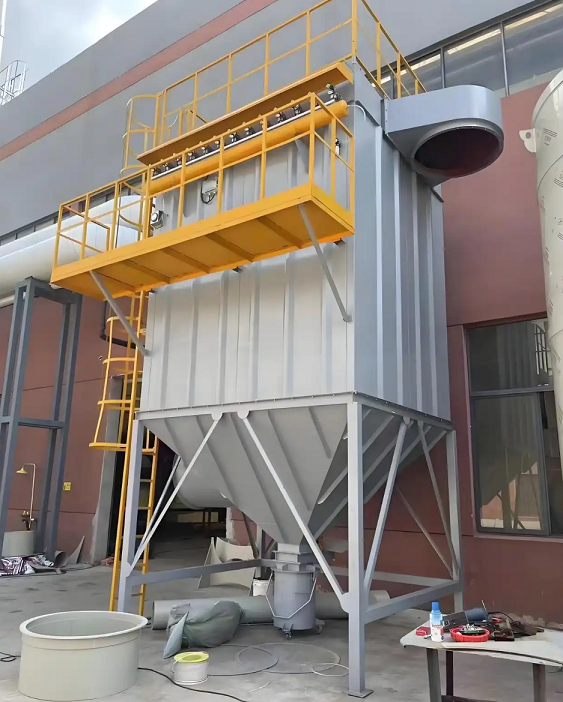
I. Working Principle
A high-pressure pulse jet dust collector is a new type of electrostatic precipitator. Its working principle is based on a high-voltage pulse power supply. This power supply superimposes high-voltage pulses onto a constant high-voltage DC level. Utilizing the characteristics of the high-voltage pulse’s steep rising edge, narrow pulse width, and short duration of electric field application, the voltage pulse amplitude reaches a very high level. This allows the gas to be fully ionized, enabling dust particles to acquire a greater charge. During the pulse interval, dust particles move towards the collecting electrode under the influence of the Coulomb force generated by the DC high-voltage electric field, thus achieving the dust removal effect.
II. Advantages
High-Efficiency Dust Removal: High-pressure pulse jet dust collectors can efficiently capture dust particles of various sizes, and also have a good removal effect on fine dust, with a dust removal efficiency often exceeding 99%. When treating dust generated by coal-fired boilers, it can effectively control emission concentrations to very low levels.
**Strong Adaptability:** This dust collector exhibits good adaptability to dust of different properties, such as particle size distribution, concentration, and viscosity, as well as dust-laden gases at different temperatures and humidity levels. By selecting appropriate filter media, cleaning methods, and structural designs, it can meet dust removal needs under various operating conditions.
**Stable Operation:** Utilizing pulse-jet cleaning, compressed air is instantaneously injected into the filter bags, causing them to vibrate strongly and quickly remove adhering dust. The short cleaning cycle ensures continuous and stable operation of the dust collector.
**Energy Saving and Environmental Protection:** The high-pressure pulse dust collector features a compact design, small footprint, and low energy consumption. Simultaneously, its high-efficiency dust removal performance helps reduce pollutant emissions, meeting energy conservation and environmental protection requirements.
III. Application Scenarios:
High-pressure pulse dust collectors, due to their high efficiency and reliable performance, have been widely used in various industrial fields. The following are its main application scenarios:
Steel Industry: In sintering, ironmaking, and steelmaking processes, high-pressure pulse dust collectors effectively remove smoke and slag generated during production, protecting the production environment and improving product quality.
Power Industry: Boiler flue gas treatment in coal-fired power plants is an important application scenario for high-pressure pulse dust collectors. These dust collectors help reduce smoke and exhaust gas emissions, protecting the atmospheric environment.
Building Materials Industry: In the production processes of building materials such as ceramics and glass, high-pressure pulse dust collectors efficiently collect and process dust, maintaining a clean production environment.
Chemical Industry: In chemical reaction processes and chemical raw material preparation, high-pressure pulse dust collectors remove harmful gases and particles, ensuring production safety and environmental quality.
Mining Industry: In the mining, transportation, crushing, and screening of ore, high-pressure pulse dust collectors can cope with complex and changing production environments, ensuring effective dust removal.
IV. Future Development Trends
With increasing environmental awareness and advancements in industrial production technology, high-pressure pulse dust collectors will exhibit the following development trends:
Intelligent Upgrade: Future high-pressure pulse dust collectors will be equipped with advanced control systems, enabling real-time monitoring and automated control of the dust removal process and equipment operating status. This will further improve dust removal efficiency, reduce energy consumption, and enhance equipment stability and reliability.
Modular Design: To improve the scalability and flexibility of the equipment, future high-pressure pulse dust collectors will trend towards modular design. Standardized modular components can be quickly assembled, replaced, or upgraded to adapt to different industrial applications and customer needs.
Integrated Application: High-pressure pulse dust collectors will be integrated with other environmental protection equipment, such as desulfurization and denitrification devices, into a compact system, forming a one-stop waste gas treatment solution. This will improve the overall system performance and reduce operating costs and floor space.
New Material Application: With the continuous development of new materials, future high-pressure pulse dust collectors will use more energy-efficient, corrosion-resistant, and high-temperature-resistant materials to manufacture filter bags and other key components, further improving equipment performance and service life.
High-pressure pulse jet dust collectors play a vital role in modern industrial dust removal due to their advantages such as high efficiency, strong adaptability, and stable operation. With continuous technological advancements and increasingly stringent environmental protection requirements, high-pressure pulse jet dust collectors will continue to be upgraded and optimized, making a greater contribution to creating a better ecological environment. In the future, we look forward to seeing more innovative technologies applied, driving further improvements in dust collector performance and providing more efficient and environmentally friendly dust removal solutions for industrial production.
Post time: Apr-08-2026