

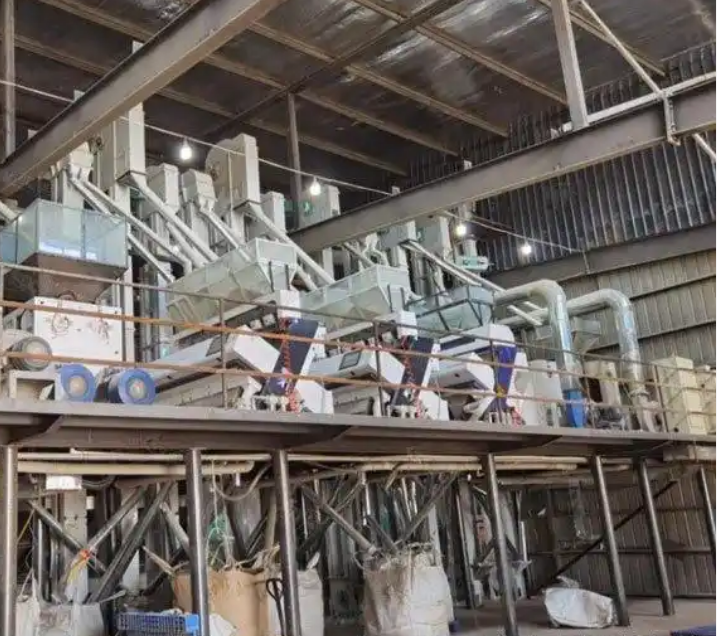
In modern rice processing enterprises, a scientific and reasonable production schedule is the core element for ensuring efficiency, quality, and cost control. A complete rice processing set typically includes key processes such as cleaning and destoning, hulling, paddy-brown separation, rice milling and polishing, color sorting and grading, and metering and packaging. The coordinated operation of each process requires meticulous management. The following are key points for daily production scheduling based on industry practice:
I. System Inspection and Preparation Before Production
1. Equipment Inspection and Maintenance
A comprehensive 30-minute inspection is required before starting work each day: check for screen blockages (especially vibrating screens and gravity destoners), ensure the huller roller gap is normal (standard 0.5-0.7mm), check the wear of the rice milling blades (replace monthly), and check the cleanliness of the color sorter’s optical lens. According to industry data, preventative maintenance can reduce the rate of sudden failures by 23%.
2. Raw Material Quality Control
Raw rice is graded and stacked according to its moisture content (ideally controlled at 14.5%-15.5%) and impurity content (not exceeding 2%). High-moisture rice must first be processed in a drying tower to meet the standards. Samples of each batch of raw materials must be retained and information such as origin and variety recorded for quality traceability.
II. Dynamic Scheduling of Production Process
1. Process Balancing Principle
Taking a medium-sized production line with a daily output of 100 tons as an example, it is recommended to adopt a “three-shift, two-operation” mode:
The processing capacity of the cleaning section should exceed that of the rice milling section by 15% (equipped with a primary cleaning screen with an hourly capacity of 8 tons).
The ratio of rice hulling to rice milling equipment should be set at 1:1.2 to avoid the “bottleneck effect”.
The color sorter should reserve 20% capacity redundancy to cope with batches with high impurities.
2. Real-time Parameter Adjustment
Dehulling stage: Adjust the roller pressure according to the rice variety (Indica rice 0.3-0.4MPa, Japonica rice 0.4-0.5MPa).
Whitening process: Follow the principle of multiple machines and light milling; control the speed of the first-stage rice milling machine at 1000 r/min, and reduce it to 800 r/min in the last stage.
Color sorting sensitivity: Calibrate with a standard sample every 2 hours; maintain a rejection rate of ≥98% for discolored grains.
III. Energy Consumption and Quality Control Management
1. Energy Efficiency Monitoring System
Install smart meters for segmented metering; energy consumption per ton-meter should be controlled between 55-65 kWh:
Cleaning and destoning stage ≤ 8 kWh/ton
Rice milling and polishing stage ≤ 35 kWh/ton
Idle running time should not exceed 15% of total working hours
2. Full-Process Quality Inspection
Hourly sampling and testing of broken rice rate (Grade 1 rice ≤ 15%), germ retention rate (≥ 30%), and yellow rice grains (≤ 0.5%)
Using a near-infrared analyzer to monitor moisture changes in real time; adjustments should be made immediately if the deviation exceeds 0.5%
Metal detectors should be used before packaging; sensitivity must be Fe ≥ 1.0 mm, Sus ≥ 2.0 mm
IV. Emergency Response Plan
1. Equipment Failure Emergency
Rice huller jamming: Immediately activate the bypass channel and use backup equipment (it is recommended that critical equipment maintain a 10% backup rate).
Color sorter mis-sorting: Switch to manual sorting mode and simultaneously check the status of photoelectric sensors.
2. Process Anomaly Handling
When a decrease in whole rice yield occurs, prioritize checking:
① Whether the rice varieties are mixed
② Whether the rice milling chamber temperature exceeds 45℃
③ Whether the rice sieve aperture is worn beyond the standard (standard 1.0mm)
V. Closed-Loop Management of Production Data
1. Digital Recording System
Use the MES system to collect equipment operating parameters (vibration frequency, current load, etc.)
Generate a quality file for each batch, including broken rice curves, color sorting rejection data, etc.
2. Standardized Shift Handover
“Five handovers” of equipment status (temperature, pressure, speed, output, fault records)
“Three checks” of remaining raw materials (variety, quantity, moisture value)
VI. Personnel Training and Optimization
1. Skill Matrix Management
Operators must master:
Basic equipment principles (e.g., how to adjust the damper of a gravity destoner)
Rapid fault diagnosis (judging rice mill bearing wear by sound)
Sensory quality assessment (judging the degree of milling by the cross-section of rice grains)
2. Continuous Improvement Mechanism
Weekly quality analysis meetings are held, and the PDCA cycle is used to optimize processes. Excellent companies can control processing losses below 4.5%.
Through this systematic approach, not only can continuous and stable equipment operation be ensured, but the following can also be achieved:
Processing accuracy standard deviation ≤ 0.3 (national standard GB/T1354 requirement)
Overall equipment efficiency (OEE) increased to over 85%
Processing cost per ton of rice reduced by 8-12 yuan
It is worth noting that companies of different sizes need to adjust their solutions according to local conditions. Small factories can adopt a “centralized processing + time-sharing maintenance” model, while large intelligent factories can introduce digital twin technology for virtual commissioning to further reduce non-value-added time. The ultimate goal is to achieve efficient utilization of the equipment throughout its entire lifecycle while ensuring the rice’s palatability score (maintained above 70 points).
Post time: Jun-12-2026